Showing posts with label Carnegie review. Show all posts

Tuesday, 24 May 2016

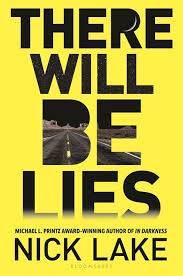
Carnegie shadowing review - There will be Lies

Imagine a weave of really big themes, Native American mythology, police pursuit, a lost child, dream sequences and a really brilliantly portrayed snarky deaf girl - oh and lies - and you have Nick Lake's US-set thriller ‘There Will be Lies’. Buckle up for a bumpy ride.

The whole story is told from the point of view of Shelby, who is nearly eighteen, but has been brought up living a very sheltered, very routine existence of books, baseball, ice cream dinners; home-schooled by her mum, Shaylene. 
We spend the whole journey in Shelby’s shoes and boy, do we get a great, multi-dimensional heroine. And she needs to be tough for the journey she takes us on.

We are catapulted into action when Shelby has an accident, and immediately the outside world threatens to intrude into their very contained and private existence and she and her mother take off, her mother exhibiting increasingly erratic and violent behaviour and Shelby not really knowing what is going on.

As if that's not enough, Shelby has vivid dreams that taken on greater importance as the story develops. All her life Shelby has had a recurring dream about a child in hospital, crying, and Shelby wanting to save the child, but never being able to get to her and now she is given a quest in the dream world that she must kill the crone and save the child or the world will end.

The twin stories increasingly collide as the story progresses, with Shelby forced to face horrible truths about her life. Soon Shelby won’t know who to trust and there will never be any going back.

The lies Shelby must face would be devastating for anyone, yet she shows amazing resilience, using the journey she is doing in the Dreaming to help her to deal with the truths she must face up to.

The real strength of this book is not even that the twin stories are told with panache and thrills. It's the main character, Shelby that holds the whole thing together. 

She deals with the extraordinary and the tough bravely, particularly for someone who has known so little of the world. 

But what is most impressive, in an already impressive book, is that the main character is profoundly deaf. The way she responds to the world and the world responds to her is so skilfully done, her deafness giving the story yet another dimension, actually sometimes softening the huge emotional rollercoaster she is going through as she has to struggle to understand at all what everyone is trying to communicate and to make herself heard.

There are rich themes explored here – nature versus nurture, how sometimes people can love us and want the best for us, yet still trick us, so that, ultimately, the biggest reward you can achieve is of self-reliance.

But Shelby is a character you are rooting for the whole way.

Shelby may also just be strong enough to run away with the Carnegie Medal this year.


Tuesday, 3 May 2016

Carnegie Shadowing - review - Five Children on the Western Front

Flying a solitary Carnegie flag for middle-grade fiction, Kate Saunders' hugely engaging 'Five Children on the Western Front' will have to hold its own if it is to take home the Carnegie Medal as the only book on the list not written with teens or young adults in mind.

This novel about families and wishes is a stunning follow-up to E Nesbit's classic 'Five Children and It' and was published to coincide with hundredth anniversary of the start of the First World War. Writing a follow-up to such a classic and well-loved story is not a challenge to take up lightly.

Its starting point is to take the original cast of characters, all grown up now and poignantly, of the generation of Edwardian children who would have been at the heart of the fighting, but the narrative cleverly takes up the story of the younger siblings, at first excited by the news of war.  


As a historical novel it is an exiting time very rich with possibility. Change is happening all around - from women's rights to social mobility, it's an exciting time to be a child. One of the girls finds determination not simply to offer charity to the sick, but to become a doctor herself. The tennis court is dug up to plant potatoes as shortages bite. No-one escapes the impact of the war.

But the heart of the story is the arrival in the children's lives of a sand fairy - a magical character taken from the original book, the Psammead, who can move people backwards and forwards in time. 

For years the younger children have been hearing stories about him and the adventures they had when he granted wishes. But when he re-appears it is not to take them on exciting adventures. He is unwell and needs looking after. Perhaps this time he is here with a bigger purpose?

The narrative engagingly entwines the social history of the day and fires up the imagination even more with the magical elements of the sand fairy. Kate Saunders effortlessly juggles a huge cast of characters that you grow to know and love throughout the novel

The fantasy twist lends a lightness and humour and makes it a really accessible and enjoyable book, which is, ultimately, a sad novel about loss and the impact of the War that packs quite an emotional punchSome lives may be short, but where they touch, they touch deeply.

The Psammead himself is undoubtedly the star of the show, prickly, ungracious and often unkind, but managing to grant enough wishes so that the children get to visit their older brother at Christmas in the trenches, and there is just enough magic to allow a few happy endings.

Will it win?

Does this war story with a magical twist pack enough of an emotional punch, deal realistically with historical social issues, yet still be an absorbing story to enthral younger readers? Can a book for younger readers impress the judges enough?

First published in 2014 it has already garnered awards, winning the Costa Children's Book Award of 2014 and going on to be shortlisted for the Guardian Children's Fiction Prize 2015. So it has already demonstrated it is no lightweight when it comes to prize-winning muscle.
It does all of the above and will be enjoyed by anyone who appreciates thought-provoking and moving children's fiction whatever their age - and is probably one of the best and most accessible books about the First World War, delivering a great sense of the loss and social upheaval, without being grim.

It may also cause children to seek out the original, or some of the other classic E Nesbit stories and may prove to be equally as timeless. Following up a classic and creating a totally new classic? Now that is a seriously impressive achievement.


Monday, 25 April 2016

Carnegie 2016 Shadowing: Review - The Lie Tree - Frances Hardinge

After storming its way to win the title of overall best book of 2015 in the Costa Book awards, it's a delight that Frances Hardinge's 'The Lie Tree' is on the shortlist for the  CLIP Carnegie Medal, awarded annually to the writer of an outstanding book for children. Because this is a book that deserves to be read and enjoyed widely.

The Lie Tree - Frances Hardinge

One of the best and cleverest things about 'The Lie Tree' is that it has the pace and page-turning absotbtion of a thriller, but Frances Hardinge cleverly uses the murder-mystery platform to weave in truly complex themes - scientific jealousy, how lies can damage small communities, and the role of women in Victorian society. And deals with these big issues in a really gripping way

The main character is a feisty heroine, courageous, intelligent and stubborn. Faith would love to be a scientist and serious, like her father. She rather despises her mother's fripparies and choice of pursuits. But in Victorian times, this is definitely a man's world and Faith may know a lot about science, but she has much to learn about society.

Faith can be more intelligent than most of the people around her and know and learn plenty, but she's encouraged to keep these talents a secret. It's a real challenge to be taken seriously, particularly when she becomes convinced her father has been murdered. 

But as she starts to investigate on the sly, she learns what women can be good at - manipulating and working behind the scenes and secretly doing things no-one would expect a woman to do. She sets about covertly trying to find out what her father was really working on and who might have guessed his secret.  Because, as a woman, no-one really suspects what she is up to.

Without any of her growing number of enemies knowing, she gets closer to bringing her father's secretive scientific studies to fruition, while also plotting how to reveal what really happened to her father.

This is a page-turner with a serious heart. It's a thought-provoking and imaginative tale that manages to weave a historical scientific adventure with a thread of feminism and fantasy. Not an easy thing to pull off, but Frances Hardinge does it with lashings of style.

There is much discussion about the elusive 'cross-over' novel - one that can be read and enjoyed by both children and adults. But these are more rare than you might think. It is not an easy path to walk to write something that can be enjoyed on so many levels - being both simple and complex at the same time, but 'The Lie Tree', in its complexity and ambition, moves writing for children definitely into an adult sphere, yet bringing also a page-turning quality. 

So can Frances pull it off - 'The Lie Tree' being the best novel of the year and being the best novel for children?

We will wait and see, but whatever happens it should bring many new readers to Frances Hardinge's tremendous writing. She is well worth discovering.

Really enjoyable, very clever, and a seriously impressive read.

Saturday, 23 April 2016

Carnegie 2016 Shadowing: Review - One - Sarah Crossan

Spring time is here, and that means it's the season for awards, most notably the CLIP Carnegie Award, and so we commence our annual shadowing of the shortlist.


Our first Carnegie shortlist reviews is the adptly name ONE by Sarah Crossan. I’ve been a fan of Sarah Crossan’s work since I reviewed ‘The Weight of Water’ for our 2013 Carnegie coverage [to read press here]. I’m not the only one, as she made it on to the Carnegie shortlist again this year with Apple and Rain which Claire reviewed a few weeks ago [press here to read].


One of the things I love about Sarah’s work is that she tells her story through verse, initially I was concerned that it may make the novels stodgy and difficult to read but I could not be more wrong. As the poems are short they minimise description therefore getting to the action, story and emotional heart of book without long wordy passages making them easy to read.  Each poem tells an extract of the story, together building up to deliver the whole story. Using this unique form of storytelling, Sarah Crossan tackles subjects which become dark and gritty in a little and engaging way.
Sarah’s latest book, ‘One’ is told in this way, it brings you into the mind of teenager Grace, displaying her insecurities and all her teenage anxieties  as she deals with her complicated family life and her twin sister Tippi. Being sisters and twins, Grace and Tippi have a strong bond, they have all the issues any other siblings face, and a good few more besides as they are conjoined. One, shows Graces inner feelings as she and Tippi venture to school for the first time, and as her family’s situation spirals when her mum is made redundant, and with medical bills piling up her Dads drinking problem worsens, even their younger sister Dragon has to work.

Seeing her family struggle, Grace persuades Tippi to allow a journalist to make a documentary about them, but as the camera’s begin to roll Graces secret is unveiled, and her health begins to fail, jeopardising both her and Tippi’s life.

One, is a moving story, it depicts the complications that life brings being conjoined, but it also explores the themes of family, love and individuality.


Friday, 19 June 2015

Carnegie Shortlist Review - The Middle of Nowhere by Geraldine McCaughrean


‘The piano arrived too late to stop the sky falling in.’


The intriguing first line of The Middle of Nowhere introduces the reader to a compelling setting and interesting characters. We go on to learn that Comity Pinny’s mother has suddenly died. Comity and her father, Herbert, are numbly absorbing this, and soon they begin reacting to their grief in very different ways. Comity finds some solace in her friendship with an Aboriginal boy, Fred, who was also close to her mother. Unfortunately, even this small measure of comfort is threatened by the station assistant, Quartz Hogg. His cruelty towards Fred opens Comity’s eyes to the racism that Aboriginals face from her own community, and along with her own mistruths, and a sprinkling of dead bodies, the story changes direction, culminating in a thrilling ending.

Comity is a beautifully rounded character who is brave and has an engaging imagination. The way Geraldine McCaughrean reveals different aspects of how she copes with the death of her mother through Comity’s own viewpoint, and later, though another character’s, is truly masterful.

The Middle of Nowhere of the title is the only home Comity has known, in the remote Australian outback, where Herbert mans the wireless station. Geraldine McCaughrean’s vivid yet simple descriptions infuse every line of the story, and it has a stronger a sense of place and time (it is set early in the last century) than I’ve read in any other children’s book this year. This is also enhanced by Fred’s Aboriginial legends and Comity’s Bible stories and hymns, which they teach each other.

This book is recommended by its publisher for children aged 11+. The tricky themes of isolation, grief and racism are handled with sensitivity, and I agree with this recommendation. However, some young readers I’ve discussed this book with have reported putting it down and not coming back to it - the narrative does have a slow start. They have been encouraged to hear that the second half of the book has a lot more action. Other young readers have raved to me about the beauty of this book, appreciating how the quieter beginning helps establish the parallels between the isolated and lonely location and the inner lives of the characters.

Everyone familiar with the prolific Geraldine McCaughrean’s work knows that they have a treat in store when she releases a new book. She has only won the Carnegie Medal once before, in 1989 for A Pack of Lies. The Middle of Nowhere is a beautiful book that thoughtful readers will gain immense pleasure from for many years to come.

Friday, 5 June 2015

Apple and Rain - Carnegie Medal - Review


"A story about sad endings. 
A story about happy beginnings.  
A story to make you realise who is special.”


   Apple and Rain is an utterly absorbing book about thirteen year old Apple, who lives with her grandmother. She has some problems that are typical of a child of her age - a rocky friendship, an annoying neighbour and a crush on an older boy who doesn’t know she exists. But she’s also affected by much deeper issues - her grandmother is extremely overprotective, her relationship with her father is rocky, and her mother abandoned her to run off to America. Apple isn’t even sure if her only memory of her is real. And then comes the thing she always thought she wanted - her mother returns.


   A few chapters into the story, we have a set of familiar ingredients for an angsty-YA novel. Yet already this book is pulling us in deeper and faster than its synopsis might suggest; it is much, much more than the sum of its parts. Partly this is achieved by Sarah Crossan’s writing, which is deceptively, and beautifully, simple. And partly it is due to Apple herself, whose responses to the escalating turmoil of her mother’s return have us cheering for her and fearing for her in equal measure.   

  The cast of supporting characters also increase the depth and impact of this story. Apple’s flighty parents, dependable grandmother, easily-led school friend and unobtainable crush all go way beyond the cliched stock characters that we might initially expect. And there are three other supporting characters who quickly became my favourites. Del, Apple’s quirky neighbour, is a wonderful revelation. He begins as comic relief, but ends up bringing so much more to the story. Apple’s inspiring English teacher introduces the major theme of the truth and meaning to be found, and revealed, in poetry. Through his nurture of her burgeoning talent, Apple discovers Emily Dickinson’s  “Tell all the truth but tell it slant”, which is at much of the heart of this novel. And finally, the eponymous Rain. The heart wrenching heart-of-the-novel, Rain. But saying any more than that would be a spoiler, so I won’t. 

It is difficult to write about Apple and Rain without making it sound like a book that is purely for teenagers. But it isn’t. I cannot recommend it highly enough, for adults as well as teens and tweens. It is recommended for ages 11+ and Sarah Crossan deals with Apple’s considerable difficulties with sensitivity and a really light touch, so tweens really will find it accessible. There is none of the cynical, controversial content that some YA books seem to revel in, and this, if anything, helps it pack a bigger emotional punch.  
Apple and Rain is a slim book and a fast read. But it’s a story to return to: I read it it one sitting, then, ignoring the pile of other books needing my attention, immediately flipped to the front and started over. It contains universal truths about the different kinds of love, revealed through one of the most interesting young protagonists I’ve read about this year. Sarah Crossan has been shortlisted for the Carnegie Medal before, and I hope that this time she wins it. Though, if not, her next novel, One, is released in August of this year; you won’t be surprised to hear that I’ve pre-ordered it.

Friday, 15 May 2015

Carnegie Review - Cuckoo Song by Frances Hardinge


Cuckoo Song opens with the awakening of eleven year old Triss, who after a near-drowning has gaps in her memory, and also, somehow, in herself. Her little sister, Pen, knows she’s not right, and hates her for it. So do her dolls. And her overanxious parents are increasingly suspicious, which leads Triss to investigate what happened on the day of the accident at the pool known as ’the Grimmer … black as perdition and narrow as a half-closed eye'.

Cuckoo Song is a changeling story with a twist; it is told from the perspective of the changeling herself. But the twists don’t end there. Its characters are rarely who they initially seem, forcing Triss to rapidly change her allegiances. The readers loyalties change too, as the characters' competing ideas of what is right and good is explored, and how far they’ll go in following them is exposed.

The world these characters inhabit also twists, from the evocative 1920’s England of the opening, to the increasingly creepy magical structures built within it. And the theme of building extends throughout the story, with characters including a menacing architect and the mysterious Shrike, who animates objects into living beings, to the themes of rebuilding a family after betrayal and building a life after the death of another, or of oneself.

This is a long book, and the tension mounts gradually in the first quarter, until eventually taking off at breakneck speed. But throughout, Cuckoo Song is filled with rich folklore and the unique, descriptive flair of Hardinge, a multi-award winning children’s novelist.

Reviewed by Claire McCauley

Friday, 8 May 2015

Carnegie Short-list Review & Mini Interview - Buffalo Solider by Tanya Landman

Buffalo Solider is an astonishing tale about a child who is born into slavery, survives the American Civil War, and grows up to become a solider riding into savage battles with native Indians.


Tanya Longman's short-listed, historical YA novel Buffalo Solider, is a fascinating tale which stretches from the period leading up to the American Civil War through the Indian Wars to the waning of the Wild West. What makes Buffalo Solider stand out isn’t just the impeccable writing and gripping voice but the perspective. Most books, films and documentaries about this period in US history usually centre on the political struggles in the exclusively white Washington or the battles between the Yankees and the Confederates. Few texts give heed to the people that the outcome of the war affected most or the ramifications it had on those who were enslaved. In Buffalo Solider, Tanya Langman has tackled this subject from the eyes of Charlotte, a slave on a plantation, whose world is ripped apart by war and the promise of freedom. 


Charlotte’s voice is compelling and uncompromising; showing a girl with great resolve and sprit who witnesses the horrors of war and soon discovers that freedom doesn't mean safe. With no home, food, or prospects and ever growing racial hatred, Charlotte takes extraordinary measures to keep safe.

‘What kind of girl steals the clothes from a dead man’s back and run’s off to join the army? A desperate one that’s who.’

Hiding in plain sight, Charlotte becomes Charlie and lives by man’s rules. She rises up the ranks in the new Black Army Legion, Company W, fighting the ‘savage’ Native American and negotiating the hostilities of the rival white legions.

“…I find that there aint nothing that makes you feel quite so alive as when you’re staring Death right in the face and every second might be your last.”

As Charlie, becomes a weathered solider and the role of the ‘Buffalo Soldiers’ becomes more than just fighting Indians but moving them to reservations and rounding up any who flee, she beings to inwardly question the orders and motives of them folks back in Washington.

“The Indians got the army telling them they gotta stay put on the reservation, else they’ll be shot. But I seen with my own eyes that the food they been promised don’t show up the whole of the following winter and the whole winter is a long time to go without eating and them folks start to starve.”

Despite the horrors and injustice that Charlie see’s in her time as a buffalo solider it’s her personal nightmares that haunt her the most. The fear of boy from her childhood, with blue eyes and golden curls like an angel; Jonas. Charlie’s life becomes infinitely more difficult when Jonas becomes captain of Company W.

“The last thing I see Jonas do is point at me with one hand. He put the other to the side of his neck and clench it into a fist. Then he jerks it up sudden, cocks his head to the side, lets his tongue loll out like he’s been hanged.”

Landman has written and book that grips you from page one and doesn’t let go until the final line. Charlotte is a strong and empathetic protagonist that makes you want to see her rise out and find peace and contentment. The writing is well crafted with subtle and powerful metaphors, like the bear cubs that are kept for amusement then freed only to freeze to death or the stirring up the ants to make them battle…

Ruben would take a stick and stir up a pair of ants’ nests. He’d get the red ones fighting the black.”

Buffalo solider looks at the issues or war, delving into the darkest traits of human kid, and question the notion of freedom, something that most of us take for granted. It is a triumph, a truly engaging read, although recommended for Young Adult readers due to subject and historical language.


Mini Interview with Buffalo Soldier author Tanya Landman


What is your Favourite thing about your book Buffalo Solider?

What I love about Buffalo Soldier is Charley. There are some characters you don't create - it's more like they're standing at your side telling you their story. Charley is one of those. I love her strength and her humanity.


Monday, 23 June 2014

And the Carnegie goes to... Kevin Brooks for The Bunker Diary!

This years list for the Carnegie was an amazing array of powerful and thought provoking reads, although we opted out of predicting a winners, we hand on heart, said we thought The Bunker Diary was a real contender. So here is a big  congratulations to Kevin Brooks!


Our congratulations also to The Greenaway picture book winner Jon Klassen for This is Not My Hat.

Also congratulation's to all the short-lister's, for making it on to the most prestigious list in the publishing calender!


Friday, 20 June 2014

Heartwarming, heart-thumping or thought-provoking? Which will take the Carnegie Medal?


Again this year’s crop of shortlisted titles are all so good and diverse that it tricky to see which will be awarded the medal.


Sometimes a runaway winner emerges and sometimes a runaway popular favourite emerges, but, this year the list appears all of the titles have intrigued or been loved in equal measure.

We always love reading the reviews posted on the shadowing site – where children are not afraid to say they failed to engage with a book or how, despite initial trepidation, could not put it down.

But it is great to see books inspiring and challenging, sparking debate and a love of reading – and all of this before the winner has even been announced.

But with the winner announcement imminent who does Space on the Bookshelf think will win? Or should win?

Sally: I for one, loved all three of the shortlisted books that I reviewed, each one unique and up-put-downable. ‘The Child’s Elephant’, has moments of writing perfection, so strong and proactive, that it makes any want-to-be-writers stunned in awe and then want to cry, it also has the most amazing story, which made even more poignant by recent events.

Nicki: ‘Liar & Spy’, with its gentle, unmelodramatic story about bullying has to be a contender. It won the Guardian fiction prize and manages to be an accessible, intriguing middle-grade story with appeal for children of all ages, but also cleverly tackles some serious issues in a non-heavy way. Masterful subtle writing and a lesson in the most powerful thing in a book being the connections the readers make themselves.

Sally: ‘All the Truth that’s in  Me’, one of the few historical titles on this year’s list, takes a totally unique stance to delivering the story, with a voice that’s strong and totally refusing to be defined by other perceptions, it’s full of hope.

Nicki: ‘The Wall’ is another great example of the increasingly blurry line between children’s and adult fiction. It was published both as an adult’s and a children’s title and very cleverly uses a child’s eyes to explore a sensitive, political subject that’s not easy to grasp, but it is done through a boy’s adventure story, full of daring and danger.  

What is does incredibly well is being a novel that informs as well as entertains and manages to be a really exciting novel for children first, while also being about serious issues with a bigger picture woven in. This is my pick for the one the judges will be awarding the prize to.

Nicki: Anne Fine’s ‘Blood Family’ is another book that could just as easily sit on adult shelves. The ability of Anne Fine to get under the skin of a damaged child is a seriously impressive piece of writing that could keep many adult book groups talking. As she has won the Carnegie Medal twice before must make her a serious contender. But I do have my doubts that it is the sort of books that children will really adore and take to their hearts.

Sally: ‘The Bunker Dairy’ is a jolt. It is an uncompromising read that deals with some truly grim and disturbing themes, yet has a character voice which is so intoxicating that you find your knuckles going white whilst you reading veraciously to see what happens next.  I think of the three that I read, the book that really stood apart and in both feel, concept and voice has to be ‘The Bunker Diary’, to deliver such a dark tale and make it so readable is no mean feat, and I believe it to be a real contender for the medal.


Claire: 'Ghost Hawk' has a beautiful sense of place and use of imagery. Susan Cooper has had books nominated for the Carnegie Medal three times during her long career, and I'd love to see her finally win with this wonderful book. However, she has attracted a small amount of criticism, ranging right from colonialism for her portrayal of the Native American culture, through to a prejudiced view on the motives of the European settlers. I felt she'd dealt with these issues in a very balanced way, but perhaps the difficult politics of her subject might stop the judges awarding her the ultimate accolade - this time.

Nicki: ‘Rooftoppers’ seems to be the story that many children have taken to their hearts. The idea of never having known your mother is something that can make all children think and wonder. To what lengths would you go to if you felt their mother was out there, if only she could be found?

The most outstanding thing about Katherine’s writing is definitely her metaphors – and if the Carnegie was awarded on metaphor alone, she would win hands down, no doubt. If it was awarded for a heart-warming, thumping good read it would also be the outright winner in my opinion. 

All of them together make for an inspiring selection that will surely help to encourage a whole range of young readers to engage with books and take new and different things from stories.

I think this year we have all decided that we long for 'Rooftoppers' to win. It is in the marvellous tradition of previous winners such as Philippa Pearce, Eleanor Farjeon and Frank Cottrell Boyce in being a story that is all about possibility, which is such a tremendously inspiring thing for a children's book to be about.

We can't wait for the final result next week!


Wednesday, 18 June 2014

‘The Wall’ - William Sutcliffe - Carnegie Review 2014

When Josh loses his football and heads off down a tunnel to try to retrieve it he emerges in what seems to be a different world.

But the world Josh has entered is no fantasy world – it’s subtly done so that the place Josh has entered is not mentioned by name until the story is well underway. But Josh lives in Amarias, an Israeli settlement in the West bank behind the 'Separation Fence' ('The Wall') and the tunnel takes him into the world of the Palestinians.

It’s a dangerous place, but Josh is intrigued by it and drawn to it, wanting to discover more, in the way boys approaching manhood will start to want to leave domestic safety and explore the big wide world.

Every time he comes back he learns a little more about the lives of people who live so close to him and yet so apart, yet puts himself in danger.

He starts a chain of events that threaten lives on both sides of the fence, but might just get him killed. It’s a fast-paced exciting story, but not without the introspection that allows Josh to work out that the situation is not at all as it had been told to him.

‘The Wall’ was published in both adult and children’s editions and is both an adventure novel and a coming of age story where a boy begins to see the world around him with fresh eyes and all its moral uncertainties. The difficulty he faces is trying not to simply repeat the behaviour of parents – to be part of the generation who stops the war and who makes a difference.

It is surprising, intelligent, heartbreaking, and beautifully told. I was completely blown away by this brilliantly told coming-of-age tale which will leave you with shredded nails but hope in your heart.

We asked William Sutcliffe what was his favourite thing about his shortlisted book: 'My favourite thing about “The Wall” is that it is designed to work as a political novel for adults about a real place, while also making sense for teenage readers as a dystopian novel in a setting that could be entirely fictional.'

Monday, 16 June 2014

‘Liar & Spy’ by Rebecca Stead - Carnegie review

This is a deceptively short and simple tale of the new friends Georges make when he has to move home. But it is actually a clever and sophisticated piece of storytelling in that most of the intrigue of the tale is in what is left unsaid, rather than what appears on the page.

When Georges moves house he makes friends with Safer, who live upstairs. Safer is homeschooled and is getting interested in the mysterious activities of one of the other residents of the apartments.

Georges gets drawn into Safer’s schemes, but things start to unravel as Safer starts to put greater demands on this new friendship in this this quirky, original story.

Books for children are often very plot-driven, with straightforward storylines, but in very few words, Rebecca Stead weaves several plotlines and plays with the reader’s understanding of what is going on.

Georges is a complex character, dealing with difficulties at home and at school. Rebecca Stead subtly plays with perspective on some of the power struggles that go on in children’s relationships and it is only as things are slowly revealed that the reader can understand


It’s a great story about standing up for ourselves. Why do we let the bullies make up the rules and why do we play them, is the central question of this really delightful and intriguing tale which is never short on surprises.

Friday, 13 June 2014

‘Rooftoppers’ by Katherine Rundell - Carnegie review

Baby Sophie is rescued from a sinking ship and, grows up believing that her mother died in the shipwreck.

But when he slightest of clues means there is a chance of tracking down her mother, Sophie, and scholarly Charles, who has brought her up in London, head to Paris in search of the truth, and the start of an out-and-out adventure story.

Sophie and Charles are used to staying one step ahead of the authorities, as the eccentric way Charles has looked after Sophie means she is only a step away from being taken to an orphanage.


But in Paris Sophie finds helps in her impossible quest from an unexpected quarter – from a bunch of children she meets who scrape a living on the Paris rooftops. Now on the run from police, Sophie sees a way she can still search for her mother. But first she must learn to scale ancient buildings in the dark, must learn to tightrope and to win the trust of the Rooftoppers.

It’s a magical tale, of children getting together to help each other and has a feel of a fairytale about it. But the thing that surprises on every page is the imaginative writing. Katherine’s way of telling the story, her fantastically imaginative word play, means there is plenty to enjoy and delight.

It’s in a great tradition of storytelling. It has huge appeal and, from the children I’ve talked to about their Carnegie experiences this year, it is the book people have most been pleased to have discovered through the shadowing.

It’s a great story about being yourself, not fitting in and a theme of believing the impossible. Great to have such an enjoyable, uplifting and well-written story for younger readers on the list.

We asked author Katherine Rundell what was her favourite thing about her shortlisted book.

"My favourite thing about Rooftoppers is the night-time tightroping scene, when Sophie walks across a rope high above Paris. I've always loved tightroping and wire-walking, but imagining what it might actually be like gave me unexpected jabs of dizziness. It took seven or eight rewrites to get that scene as close to right as I could make it, but it's now one of my favourite things I've written."


Wednesday, 11 June 2014

'Blood Family' by Anne Fine - Carnegie review

It opens like a thriller, digs deep emotionally and tackles contemporary issues without either dumbing down, over-sensationalising or making a melodrama out of serious subjects.

This year Anne Fine’s ‘Blood Family’ definitely seems to have been the one on the Carnegie shortlist where the content has both surprised and shocked.

‘Blood Family’ is a modern-day story about Eddie, a boy with plenty of problems to fill a book. We meet Eddie, traumatised and imprisoned, aged seven, when the police arrive at his home to rescue Eddie and his mother from a violent relationship.

The intensity of this opening makes for a disturbing start, a menace that never lets up. Yet, however much Eddie’s world seems apart from our own, we get drawn in to understand, which is a great testament to Anne Fine’s concise, appealing writing and her characterisation of Eddie. But it’s the lean and no-nonsense way she handles some really tricky issues that really impressed me about this book.

The story, you have to say, is unusual in itself as a topic of a book for children. But it further stands out in that there are multiple points of view to Eddie’s story – teachers, social workers, foster carers, adoptive parents – and most of them are adults. All with a view, all terribly nice and doing the right thing. All of them are kindly and well-meaning. But none of them really able to understand Eddie.

It’s a downbeat view of how ill-equipped society is to try to rehabilitate children like Eddie, despite lots of very good intentions. And although we’d all like to think there are very few of them, the truth is they are in the headlines depressingly often. It’s strong stuff and definitely aimed at teenage and older readers and would certainly be just as suitable for adults. I felt I enjoyed it much more with my adult eyes than in trying to think how children would come at this story.

The violence isn’t notably worse than in a lot of young adult fiction, but the feeling Anne Fine creates, how she cleverly creates her reality, certainly makes it a story that will stay with you for a long time.

On being freed, Eddie finds it really difficult to relate to the world around him, yet he is sweet and a character easy to warm to.

If there is one thing that living with a violent father has taught him – it’s how to not make waves, how to make yourself almost disappear, how to pick up on signals and always, always say the right thing. So he clears the hurdles set by the social workers and ends up settled with a new family.

The psychiatrists and social workers disappear from Eddie’s life, congratulating themselves on a job well done. But Eddie’s troubles have hardly begun.

None of them have scratched the surface of how Eddie will behave when he starts to grow up and starts to think independently. Everything is there poised like a huge weight ready to topple down on him.

What you could call the second half of the book looses much of the adult viewpoint and gets more into its stride with Eddie, reaching an age of maturity and starting to question his early life. Then the wheels fall of his current, carefully constructed existence. Why did his mother never try to escape? Did she not think he was worth saving?

And the biggest question of all that truly comes to haunt Eddie – is he destined to repeat that violent behaviour? Is it somehow mapped onto his genes? If he is Harris’s son, can he stop himself turning into the monster his father became?

His adoptive family appear ill-equipped with what to expect. And as he has to keep visiting his mother, he can never start afresh and truly try to move on and forget his past. His wonderful sister is the only person who gets under the surface, but she becomes the target of his anger.

Without anyone noticing, Eddie, full of self-disgust, tries to blot out the fear and becomes dependent on alcohol, stealing to fund his habit, occasionally breaking into violence. Is he already walking in his father’s footsteps?

The descriptions of alcohol dependency and Eddie’s journey are finely described, not shying away from the truth, and although there is much to shock a sensitive reader, the violence is not written as entertainment. It is written as a read to provoke thought and discussion.

How easy it would have been to be gratuitous in situations, such as when Eddie realises one of the other inhabitants of his squat has died of an overdose. But this story isn’t using violence for entertainment, in the same way that it doesn’t make drug or alcohol abuse appear even slightly appealing.

There is plenty here that will surely provoke good book-group discussions. It’s about topics that crop up every day on the news. And, ultimately, through unstinting support, he conquers his demons.

Eddie’s voice, from damaged child to damaged adult and beyond, is a bravura piece of writing.