Showing posts with label Carnegie 2015. Show all posts

Tuesday, 23 June 2015

A BIG Space on the Bookshelf Congratulations to the 2015 Carnegie Medal Winner...


As ever the 2015 crop of Carnegie short-listed books was a bumper load of fantastic and beautifully woven stories. This make pegging for a winner difficult, but I’m totally thrilled to say a...

 Big Congratulations

to Tanya Landman for taking home the prize for her emotionally charged historical YA novel, Buffalo Solider. Buffalo Solider was one of the books that I reviewed [press here to read] and was the book that I was backing [press here to read our SOTB round-up] so I was very pleased to hear that it won!

Congratulations to all the short-listed authors, we much enjoyed reading your book, and we at SOTB look forward to reading and reviewing your future books!


Friday, 19 June 2015

Carnegie Shortlist Review - The Middle of Nowhere by Geraldine McCaughrean


‘The piano arrived too late to stop the sky falling in.’


The intriguing first line of The Middle of Nowhere introduces the reader to a compelling setting and interesting characters. We go on to learn that Comity Pinny’s mother has suddenly died. Comity and her father, Herbert, are numbly absorbing this, and soon they begin reacting to their grief in very different ways. Comity finds some solace in her friendship with an Aboriginal boy, Fred, who was also close to her mother. Unfortunately, even this small measure of comfort is threatened by the station assistant, Quartz Hogg. His cruelty towards Fred opens Comity’s eyes to the racism that Aboriginals face from her own community, and along with her own mistruths, and a sprinkling of dead bodies, the story changes direction, culminating in a thrilling ending.

Comity is a beautifully rounded character who is brave and has an engaging imagination. The way Geraldine McCaughrean reveals different aspects of how she copes with the death of her mother through Comity’s own viewpoint, and later, though another character’s, is truly masterful.

The Middle of Nowhere of the title is the only home Comity has known, in the remote Australian outback, where Herbert mans the wireless station. Geraldine McCaughrean’s vivid yet simple descriptions infuse every line of the story, and it has a stronger a sense of place and time (it is set early in the last century) than I’ve read in any other children’s book this year. This is also enhanced by Fred’s Aboriginial legends and Comity’s Bible stories and hymns, which they teach each other.

This book is recommended by its publisher for children aged 11+. The tricky themes of isolation, grief and racism are handled with sensitivity, and I agree with this recommendation. However, some young readers I’ve discussed this book with have reported putting it down and not coming back to it - the narrative does have a slow start. They have been encouraged to hear that the second half of the book has a lot more action. Other young readers have raved to me about the beauty of this book, appreciating how the quieter beginning helps establish the parallels between the isolated and lonely location and the inner lives of the characters.

Everyone familiar with the prolific Geraldine McCaughrean’s work knows that they have a treat in store when she releases a new book. She has only won the Carnegie Medal once before, in 1989 for A Pack of Lies. The Middle of Nowhere is a beautiful book that thoughtful readers will gain immense pleasure from for many years to come.

Friday, 12 June 2015

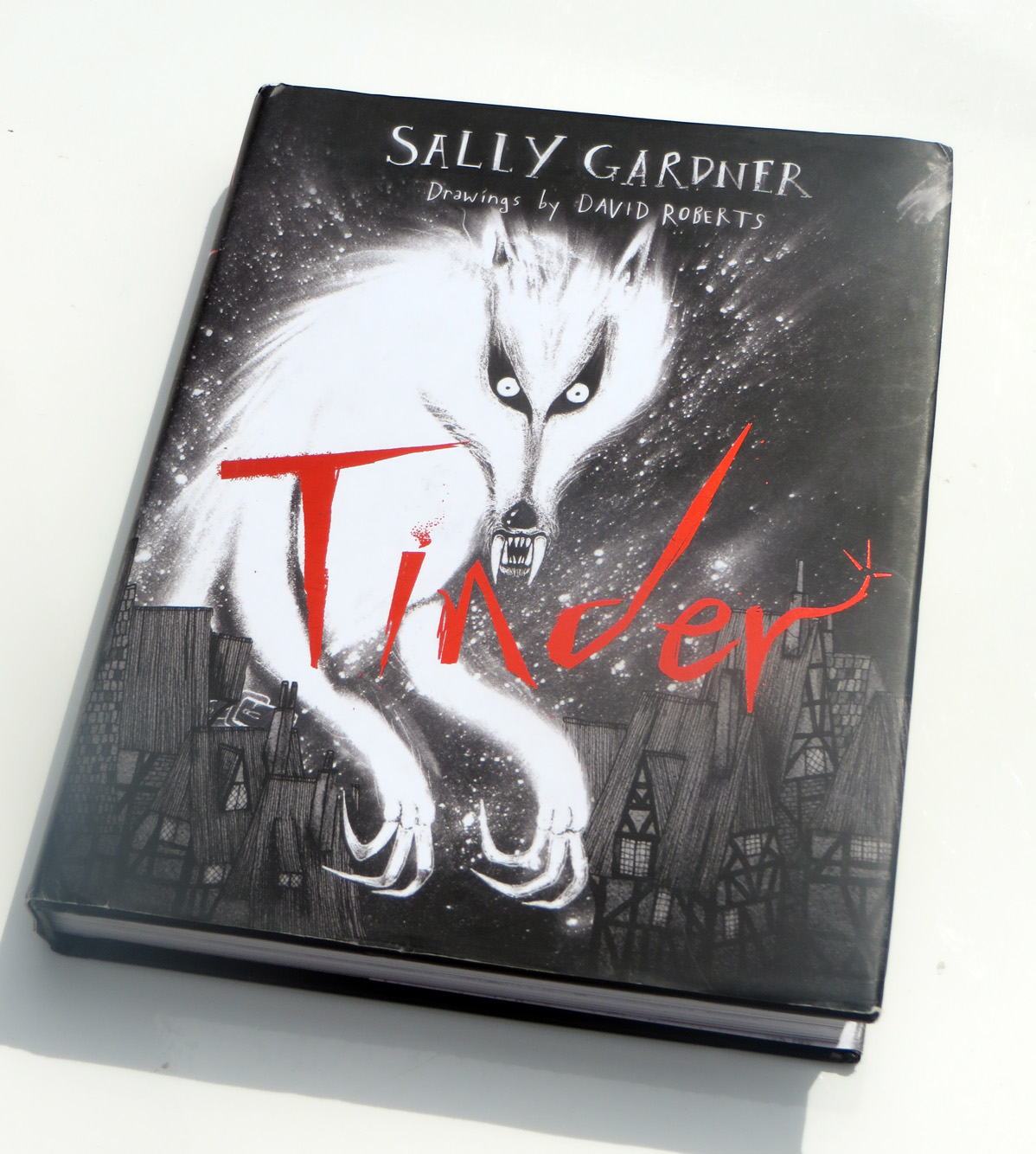
Carnegie Shortlist Review - Tinder by Sally Gardner with Drawings by David Roberts


Sally Gardner is no stranger to the Carnegie short-list, in 2013 her novel Maggot Moon scooped up the award (press here to read our review). Now she’s back with the amazingly beautiful Young Adult picture book; Tinder, which isn’t only up for the Carnegie but for the Greenaway too. So it is more than possible that Sally (and illustrator David Roberts) could walk away with an award in each hand!

Tinder is a testament to the power of fairy-tales, and their ability to evolve to be relevant in an ever changing society, as Sally takes her inspiration from Hans Christian Andersen’s dark and twisted tale, ‘The Tinder Box.’


Set in the war torn regions of Germany in the 15th century Tinder is a dark and evocative tale of one solider shun and flee the bloodied battlefields of Breitenfeld betting his future on the roll of enchanted dice.

“ ‘ I wait or no one,’ said Death.
‘You’ve feasted well today,’ I said. ‘What difference would my soul make?’
It was then that Death and his ghostly army vanished.”


The dice guide Otto through perilous forests populated with deserters, thieves and a mysterious stranger that transforms into a wolf by removing his belt. Dicing with death Otto happens by a traveller; a boy who is not quite as he seems.

“’It’s not fair that girls should be bound up in skirts. I would rather be a boy, then I would be free to travel like you’. He took his hat off and threw it down. All about him cascaded fiery curls and a young woman stared at me with defiant eyes.”

The pair fall in love yet in a land soaked in blood and defined by violence, the pair are separated as huntsman come to collect their prey; Safire leaving Otto to follow the dice in search of her.


Otto’s journey is one that brings terror and riches as he comes upon a wooden castle, home to the powerful Lady of the Nail, who sends Otto on a quest into the bowls of the castle to fetch something from under the watchful eyes of three gigantic wolves. The prize, a tinder box, becomes entwined in Otto’s destiny as he ventures on wards to save Safire from an arranged marriage and certain death.


The Tinder box brings blessings; wealth, the command over the three gargantuan lupines and a key to his ‘happily ever-after’ yet its price, a secret, which may well fashion his demise.

Tinder is written with rhythm of a fairy tales and brings a tale that’s woven with enchantment, betrayal, fear, and hope yet brings with it an image of the atrocities of war. In Tinder Sally Gardner explores the brutalities of war and the desperation of survival in a convincing fairy tale world, drawing from werewolf mythology making the story rich and layered. The book is beautifully illustrated on every page with black, white and red drawings by David Roberts that enhance the story adding to its eerie-gothic appeal. Despite the book being highly illustrated, due to some of its subject matter it is a book for older teenagers.


Friday, 5 June 2015

Apple and Rain - Carnegie Medal - Review


"A story about sad endings. 
A story about happy beginnings.  
A story to make you realise who is special.”


   Apple and Rain is an utterly absorbing book about thirteen year old Apple, who lives with her grandmother. She has some problems that are typical of a child of her age - a rocky friendship, an annoying neighbour and a crush on an older boy who doesn’t know she exists. But she’s also affected by much deeper issues - her grandmother is extremely overprotective, her relationship with her father is rocky, and her mother abandoned her to run off to America. Apple isn’t even sure if her only memory of her is real. And then comes the thing she always thought she wanted - her mother returns.


   A few chapters into the story, we have a set of familiar ingredients for an angsty-YA novel. Yet already this book is pulling us in deeper and faster than its synopsis might suggest; it is much, much more than the sum of its parts. Partly this is achieved by Sarah Crossan’s writing, which is deceptively, and beautifully, simple. And partly it is due to Apple herself, whose responses to the escalating turmoil of her mother’s return have us cheering for her and fearing for her in equal measure.   

  The cast of supporting characters also increase the depth and impact of this story. Apple’s flighty parents, dependable grandmother, easily-led school friend and unobtainable crush all go way beyond the cliched stock characters that we might initially expect. And there are three other supporting characters who quickly became my favourites. Del, Apple’s quirky neighbour, is a wonderful revelation. He begins as comic relief, but ends up bringing so much more to the story. Apple’s inspiring English teacher introduces the major theme of the truth and meaning to be found, and revealed, in poetry. Through his nurture of her burgeoning talent, Apple discovers Emily Dickinson’s  “Tell all the truth but tell it slant”, which is at much of the heart of this novel. And finally, the eponymous Rain. The heart wrenching heart-of-the-novel, Rain. But saying any more than that would be a spoiler, so I won’t. 

It is difficult to write about Apple and Rain without making it sound like a book that is purely for teenagers. But it isn’t. I cannot recommend it highly enough, for adults as well as teens and tweens. It is recommended for ages 11+ and Sarah Crossan deals with Apple’s considerable difficulties with sensitivity and a really light touch, so tweens really will find it accessible. There is none of the cynical, controversial content that some YA books seem to revel in, and this, if anything, helps it pack a bigger emotional punch.  
Apple and Rain is a slim book and a fast read. But it’s a story to return to: I read it it one sitting, then, ignoring the pile of other books needing my attention, immediately flipped to the front and started over. It contains universal truths about the different kinds of love, revealed through one of the most interesting young protagonists I’ve read about this year. Sarah Crossan has been shortlisted for the Carnegie Medal before, and I hope that this time she wins it. Though, if not, her next novel, One, is released in August of this year; you won’t be surprised to hear that I’ve pre-ordered it.

Friday, 29 May 2015

More than This – Carnegie Shadowing – review

Expect some big questions and prepare yourself for a bumpy ride when you dive in Patrick Ness’s ‘More than This’ – a novel which will leave you with more questions than answers, but also, is a book that will surely make you think. Oh, and terrify you.

The opening is mysterious as Seth discovers himself in a world he can’t explain – similar to one he thinks he remembers, but not the one he thinks he just left, when he thinks he died. (Yes, it's going to be that complicated.)

He seems to now be in a place he left when he was a child; before he moved to a different country. But that’s not even the main mystery.

The question really troubling Seth is: Where is everyone else?


From the intriguing and enticing cover, you know right from the start that you are being served up something very special.

Patrick Ness weaves three complex and intriguing threads through this book in a masterful piece of narrative structure.

The three interwoven stories – the story of Seth’s ‘other’ life and what led to him being here is told in flashback; the story that goes even further back, to when his family moved out of his childhood home; and the ‘where am I now and how did I get here?’, all add up to something really pretty special.

The story is part mystery, part thriller, part sc-fi, part contemporary novel, and part a story of the emotional consequences of a taboo same-sex relationship. But each is handled with skill so you are drawn more and more into Seth's world. The bleakness of the difficulties he has faced in his young life, plus the struggle for survival today, on top of making sense of his current situation.

It is no less than brilliant that the author manages to achieve all this, relentlessly moving from one storyline to another, dropping in clues to the back-story of each of the story threads, making you feel torn as you have to leave one story to plunge into another. Yet the reader never loses place. Each thread is equally engrossing, each in its own way. Each character and sub-plot each take you into deeper and darker places.

It’s an emotional rollercoaster, but the contemporary action is laced with menace. The baddie ‘The Driver’ a robot who seems unstoppable and un-killable is truly terrifying, punctuating an emotional story with heart-stopping threat and action.

The reader never knows what to expect next and along the way, if you take time to stop and think, the journey takes you to some terrifying places, and not just the sci-fi action scenes. This philosophical novel poses big questions. 

Is it better to live a life sheltered by the sometime awfulness of reality – or better to face the truth? Is the worst nightmare the one that’s real, or the imaginary one you create for yourself?

I was absolutely blown away by this book and I would love it to win. Such a big novel. So many questions. I enjoyed it totally on an adult level - it is really a timeless book that appeals to all ages.


My only reservation, really, is whether it is really a novel for children? I think you need a certain maturity to fully appreciate this novel on all its levels. I think many children doing the shadowing will love this - particularly the action scenes and the mystery, but I kind of also hope they might want to come back to it and read it again when they are a little older.

Is it a great novel? I would say so – unquestionably Yes. Is it a great novel for children? That is a much trickier one. 

We shall await the judges' final decision.

We asked Patrick Ness 'What is your favourite thing about your shortlisted book?' Here is what he had to say:
"The cover.  I mean, you know, I'm proud of the book like I would be of a child I raised and sent out into the world, but haven't my publishers done an amazing job with the cover?  I feel very lucky."


Thank you Patrick Ness. I agree the cover is awesome, but it is only doing justice to a truly fantastic book. 

Friday, 22 May 2015

The Fastest Boy in the World – Elizabeth Laird – Carnegie Shadowing review

You might be forgiven for thinking Elizabeth Laird’s ‘The Fastest Boy in the World’, with its Ethiopian setting and story of a boy who lives on a farm and who dreams of being a runner, might be a story children would find it a challenge to relate to, particularly as this is aimed at young readers.

But who wouldn’t understand exactly how eleven-year-old Solomon feels when his grandfather tells him they must journey together to the big city – and the excitement Solomon feels in being given this responsibility, the recognition that he is growing up and the sense that things are about to change.

We are quickly drawn into Solomon’s world. The capital may only be just over twenty miles away, but in a country where few people have cars, and even a bus journey is too expensive, Solomon and his grandfather must go on foot. And Solomon doesn’t even own shoes.

This is wonderful, evocative storytelling – a glimpse into a different land, a totally different culture. But a novel of heart and adventure.
We can feel the wonderful contrast as Solomon sets foot in a city for the first time, and understand Solmon’s excitement when they are finally plunged into the teeming world of the capital – Addis Ababa. Suddenly there are people, movement, pavements, pick-pockets – and relatives that don’t look that pleased to see them.

Solomon begins to understand some skulduggery has been afoot and prompted, for what has been for his frail grandfather, a huge journey.


But they find friends in unexpected places, plus a few stories of Grandfather when he was young are revealed – plus a little history of this troubled country.

And the backdrop of all of this is the impending returning visit and parade by the country’s running heroes fresh from Olympic success, and Solomon, always, always dreaming of running.

There is a simplicity of storytelling in Elizabeth Laird’s ‘The Fastest Boy in the World’ that masks that this is about some big themes, dealt with in a book suitable from age seven – no mean feat.

Grandfather has been a huge presence in Solomon’s life, but is taken ill. What eleven-year-old wouldn’t recognise the fear and responsibility of being alone in a vast city in charge of a very dear and ailing relative. 

Even finding the right bus would be a challenge for most youngsters, as it is for Solomon. But Solomon reacts with chivalry and courage when faced with some pretty big challenges.

It’s a really satisfying and heart-warming story that does a double achievement of helping you understand the fears, hopes and dreams of a boy in another country – and realising these are not so different from our own.

A joy of storytelling. Great to see a book for younger readers being recognised on the Carnegie shortlist - and who could fail to be moved and excited by Solomon's epic run.

Friday, 15 May 2015

Carnegie Review - Cuckoo Song by Frances Hardinge


Cuckoo Song opens with the awakening of eleven year old Triss, who after a near-drowning has gaps in her memory, and also, somehow, in herself. Her little sister, Pen, knows she’s not right, and hates her for it. So do her dolls. And her overanxious parents are increasingly suspicious, which leads Triss to investigate what happened on the day of the accident at the pool known as ’the Grimmer … black as perdition and narrow as a half-closed eye'.

Cuckoo Song is a changeling story with a twist; it is told from the perspective of the changeling herself. But the twists don’t end there. Its characters are rarely who they initially seem, forcing Triss to rapidly change her allegiances. The readers loyalties change too, as the characters' competing ideas of what is right and good is explored, and how far they’ll go in following them is exposed.

The world these characters inhabit also twists, from the evocative 1920’s England of the opening, to the increasingly creepy magical structures built within it. And the theme of building extends throughout the story, with characters including a menacing architect and the mysterious Shrike, who animates objects into living beings, to the themes of rebuilding a family after betrayal and building a life after the death of another, or of oneself.

This is a long book, and the tension mounts gradually in the first quarter, until eventually taking off at breakneck speed. But throughout, Cuckoo Song is filled with rich folklore and the unique, descriptive flair of Hardinge, a multi-award winning children’s novelist.

Reviewed by Claire McCauley

Friday, 8 May 2015

Carnegie Short-list Review & Mini Interview - Buffalo Solider by Tanya Landman

Buffalo Solider is an astonishing tale about a child who is born into slavery, survives the American Civil War, and grows up to become a solider riding into savage battles with native Indians.


Tanya Longman's short-listed, historical YA novel Buffalo Solider, is a fascinating tale which stretches from the period leading up to the American Civil War through the Indian Wars to the waning of the Wild West. What makes Buffalo Solider stand out isn’t just the impeccable writing and gripping voice but the perspective. Most books, films and documentaries about this period in US history usually centre on the political struggles in the exclusively white Washington or the battles between the Yankees and the Confederates. Few texts give heed to the people that the outcome of the war affected most or the ramifications it had on those who were enslaved. In Buffalo Solider, Tanya Langman has tackled this subject from the eyes of Charlotte, a slave on a plantation, whose world is ripped apart by war and the promise of freedom. 


Charlotte’s voice is compelling and uncompromising; showing a girl with great resolve and sprit who witnesses the horrors of war and soon discovers that freedom doesn't mean safe. With no home, food, or prospects and ever growing racial hatred, Charlotte takes extraordinary measures to keep safe.

‘What kind of girl steals the clothes from a dead man’s back and run’s off to join the army? A desperate one that’s who.’

Hiding in plain sight, Charlotte becomes Charlie and lives by man’s rules. She rises up the ranks in the new Black Army Legion, Company W, fighting the ‘savage’ Native American and negotiating the hostilities of the rival white legions.

“…I find that there aint nothing that makes you feel quite so alive as when you’re staring Death right in the face and every second might be your last.”

As Charlie, becomes a weathered solider and the role of the ‘Buffalo Soldiers’ becomes more than just fighting Indians but moving them to reservations and rounding up any who flee, she beings to inwardly question the orders and motives of them folks back in Washington.

“The Indians got the army telling them they gotta stay put on the reservation, else they’ll be shot. But I seen with my own eyes that the food they been promised don’t show up the whole of the following winter and the whole winter is a long time to go without eating and them folks start to starve.”

Despite the horrors and injustice that Charlie see’s in her time as a buffalo solider it’s her personal nightmares that haunt her the most. The fear of boy from her childhood, with blue eyes and golden curls like an angel; Jonas. Charlie’s life becomes infinitely more difficult when Jonas becomes captain of Company W.

“The last thing I see Jonas do is point at me with one hand. He put the other to the side of his neck and clench it into a fist. Then he jerks it up sudden, cocks his head to the side, lets his tongue loll out like he’s been hanged.”

Landman has written and book that grips you from page one and doesn’t let go until the final line. Charlotte is a strong and empathetic protagonist that makes you want to see her rise out and find peace and contentment. The writing is well crafted with subtle and powerful metaphors, like the bear cubs that are kept for amusement then freed only to freeze to death or the stirring up the ants to make them battle…

Ruben would take a stick and stir up a pair of ants’ nests. He’d get the red ones fighting the black.”

Buffalo solider looks at the issues or war, delving into the darkest traits of human kid, and question the notion of freedom, something that most of us take for granted. It is a triumph, a truly engaging read, although recommended for Young Adult readers due to subject and historical language.


Mini Interview with Buffalo Soldier author Tanya Landman


What is your Favourite thing about your book Buffalo Solider?

What I love about Buffalo Soldier is Charley. There are some characters you don't create - it's more like they're standing at your side telling you their story. Charley is one of those. I love her strength and her humanity.


Friday, 1 May 2015

When Mr Dog Bites – Carnegie Shadowing – review

This was the book I was really looking forward to reading for our shadowing for two main reasons – it seems to have been the one this year that has got everyone talking (and I always like to read books people are talking about).


Plus it had very high billing as a ‘Curious Incident’ for Tourette’s, which sounded very intriguing (if not extremely difficult to live up to).

Any award should include books interesting enough to get people talking, and this book has been controversial enough to make headlines. 


If you’ve already heard about this book you will probably know one thing about it – it is full of swearing.

So the question I really wanted to address was – was it on the list mainly as a book that would get children talking? Is it good enough across all areas for me to want it to win?

The concept of the book is that the main character, Dylan Mint (great name), has a very rare type of Tourettes that means whenever he is stressed he can’t stop himself verbally insulting people.


By far the best thing about the book is the really deep way that the reader engages with Dylan and his condition. You really feel for Dylan as he can’t help just going around being incredibly offensive, which, inevitably, causes lots of problems. 

It's an incredibly compassionate book that is presented in a fun and funky way rather than an overly emotional one, so will appeal to a different group of readers. Diversity and inclusiveness always get a big thumbs up from me.

Dylan is sixteen, but does have a very naive view of the world, which definitely makes the reader feel that as well as having Tourettes (basically a genetic illness of the nervous system which means the body tics and jerks) that he is in some way not fully developed mentally as a sixteen year old (is this part of Tourettes?). Not sure. Ultimately it's not really a story about Tourette's very much.

Dylan is trying to make sense of the world and care for his friends and his family. But he's a teenage boy, so he doesn't always do it in ways you might expect. His close relationship with buddy Amir is very touching.

Dylan has a close and warm relationship with his mum (his Dad is away in the army). They spend evenings together; he makes her soup, they comfortably share tv viewing. He misses his dad. Then Dylan accidentally overhears something he shouldn’t – he believes he has learned he has only months to live.

Having set up a great relationship between Dylan and his mum, you can't help but wonder why would he not want to talk to her about his imminent demise?

Knowing he will die, Dylan declares an intention of having sex, picking on a girl to whom he is mostly attracted by her trendy, branded clothing and accessories.

I liked this point and thought it skilfully made as the world is seen through Dylan’s eyes and he constantly wants people to see beyond his exterior (and that of his best mate, who suffers racist abuse rather than abuse about his disability).

The fact that Dylan himself makes many surface judgements about people was cleverly done.

The most touching scene in the book I felt, was where he discovers that he has learned to care for the girl, for who she is, flaws and all. As a book about love among disabled teenagers, the book was terrific. The disco scene is truly hilarious and the quality of the writing really shone here.

There were a lot of sub-plots. A lot. All of which were trying to tackle big issues and the book felt somewhat overloaded and relied heavily on plot devices and twists. 

There is a plot twist at the end where Dylan learns he won't die. (Mum and the doctor were actually talking about the fact that Dylan has a new baby sibling on the way.) Why the secrecy? Why does Mum not make any effort to try to prepare Dylan as much as possible for the arrival of babies into the house? 

We discover Dylan’s dad was an alcoholic, was booted out of the army, became a violent armed robber and was repeatedly violent towards Dylan’s mum and is actually in jail. I did struggle to reconcile the considerate and thoughtful Dylan, with someone who didn’t notice his mother was a victim of repeated extreme violence. 

The final twist is where Dylan’s Tourette’s symptoms are dealt with by Dylan being offered a miracle cure.

One of the best things about stories is their ability to allow you to step into someone else’s shoes.

And this is a very good book for that. 

The book is big on its ability for the reader to get under Dylan’s skin, but a bit light in its ambition in terms of dealing with some of its plot issues with the depth given to other parts of the book.

So.

You can’t discuss Mr Dog without discussing the swearing. At the start, Dylan’s swearing is mostly done with very good comic effect. Words are said unintentionally and without malice, although the words themselves are profuse and offensive, It does mean it is not a book you would recommend for some readers who would very probably otherwise enjoy it.

Not only does Dylan’s internal monologue and his dialogue start to be littered with swearing, all the children use foul language and are frequently vilely abusive to each other. Yet none of the adults ever swear.

In the end it was in danger of feeling more like a book about swearing than it did about anything else, but I was actually left feeling confused what the book was trying to say about swearing.

Author Brian Conaghan has set himself quite a challenge and he pulls off an appealing story for older teenagers about disability that is actually funny more often than grim.


Dylan is a warm and quirky character and the story of adolescent friendship and first love among the disabled made this, ultimately, an uplifting read.

There is lots here that is worthy of plenty of classroom and bookgroup discussion - absolutely a book that should and will get people talking. And I am always in support of‘difficult’ books – where would we be if everyone jumped on band-wagons and shied away from anything challenging or experimental?

For me, it would actually have been a whole lot better without half so much swearing.

My overall feeling is that ‘Mr Dog’ suffers from too many flaws for me to really have it as one of my ‘great’ books.

We asked author Brian Conaghan the question: ‘What is your favourite thing about your shortlisted book?’

"The favourite thing about my book is the friendship that exists between Dylan and Amir, it demonstrates how important having trusted and loyal friends around helps shape the person both boys become."

Many thanks to Brian - and we wish him very good luck with his original, heart-warming and thought-provoking book.

Tuesday, 17 March 2015

We interview Dawn Finch, CILIP Vice President about Carnegie and libraries

Today the shortlist for the Carnegie Medal was announced, and that means the launch, up and down the country of shadowing schemes where schools compete to read and review the shortlist – and pick and debate their own favourite titles.

To mark the occasion we are very lucky to be able to interview Dawn Finch, CILIP Vice President, about the very special place libraries and books have played in her life – and a glimpse behind the scenes of the tortuous road to picking the Carnegie winner.

What was your favourite children’s book as a child?

Oh dear, I'm always being asked this one and it's so hard to answer because I loved so many books. I chose books that fitted with my moods and current tastes and often chose with a random point of my finger when I was in the library. That's the wonderful thing about libraries - no price tag! I could choose whatever I wanted and never had to worry about the cost. I think if I am pushed for an answer I'd go for Arthur Ransome's Swallows and Amazons books. I so wanted to be Nancy and to be able to just go off and row across a lake. Those books encapsulate such a sense of freedom and exploration, and that really appealed to me as a child.

What is your favourite children’s book as an adult?

Whatever I’ve just finished! I used to stick a book out to the end even if I wasn’t enjoying it, but I no longer do that. If I’ve finished a book then that means I enjoyed it. I’m such a sucker for a good book that I do tend to fall in love with the last one I finished. I wouldn’t like to say which is my current favourite as by the time you go to print I’ll be on to the next one and will be in love with that.

 What do you think makes children’s books so inspirational?

For me it’s always been about the voices that speak to us. Young people are looking to be listened to, but they also want to be spoken to as well. A book is inspirational if it touches something inside the reader and says “yes, me too, you are not alone.” I don’t feel that young readers want to be preached to, or to have some great moral message explained to them, they just want to feel less alone. A book that can do that is inspirational.

 Why did you become a librarian?

I always wanted to be either a librarian or a writer, and I’m lucky enough to have achieved both of those things. Who wouldn’t want to be a librarian?! I grew up pretty poor and libraries changed my life. If it wasn’t for libraries I would not be me, and I kind of like me! There is no way my parents could have afforded all of the books that me and my sister ended up reading, but the library let us have them for free. In the school library I had a safe haven from bullies and unhappiness, and I found a place where I felt I belonged.

I always knew that I belonged in a library and I can’t remember a time when I didn’t want to work in one.

What is the best thing about the job? And the worst?

BOOKS! That’s easily the best thing about the job. No, really the best thing is teaching a child how to read and seeing that glorious epiphany moment when they get it, when everything clicks and they become a reader. There really is nothing like that. Recently I had a young man stop me in the street and tell me all about what he was reading and told me it was all down to me because ten years earlier I hadn’t given up on him when he’d given up on himself. He thought he’d never learn how to read, I knew he just needed the right books. That’s pretty special.

The worst thing is the current fight we are in to save libraries from people who haven’t got a clue how important they are. I’m so tired of having to explain that libraries are more than just a room with books in. I’ll never give up on that fight, but I dream of a day when we don’t have to face that struggle.

What is your vision of what a children’s library will look like in ten years time.

I try not to think of the negative aspects of library futures and prefer to dream of a buzzy and lively place full of people using their library for all sorts of things from using the computers, to studying, to reading and learning and just enjoying a vibrant and welcoming place that belongs at the heart of every successful community.

 How did you get involved with CILIP?

When I started off as a casual assistant in a public library a very long time ago, I wasn’t eligible to join CILIP and I saw membership as a validation of being a professional. I studied hard and being accredited was one of the proudest moments of my life. I felt like I’d finally arrived and was a real librarian. I’ve spent a lot of time on committees and campaigning as I wanted to put something back and, in January 2015, I was elected Vice President and now I can properly give back to the organisation that changed my life.


What are the biggest challenges in being a judge for the biggest and most prestigious children’s writing prize– the Carnegie Medal?

As part of the Presidential team we don’t actually get a vote in the Carnegie or Greenaway, but obviously we are involved in our own way. I’ve been on the reading groups in the past and it is incredibly difficult in the regional reading groups to bring it down to a decent number. I’m very glad that I don’t have to bring the list down to the final few, that would break my heart every time my favourites didn’t get through. I think it takes a very special person to be able to separate their personal opinion from those of others.

What do you look for in a good children’s book, and how does this differ from judging an adult book?

I don’t think that there is any difference between judging a book for young people and a book for adults. A good book is one that speaks to you and one that lives in your mind after you’ve put it down. I think that some people feel that it’s all about issues and adversity, but it’s really all about a book that bursts from the page and into your life and your imagination. That’s what makes a Carnegie Greenaway book.

What is the best thing about being involved in the Carnegie prize?

Well, the best thing for me is that I get all the cool stuff like chatting to other authors and reading the books without the weighty responsibility of making final decisions!

So. Let us into the secret – how do they decide which books will make it onto the shortlist? Is it terribly civilised, or is it more heated arguments and smoking guns?

The panels can get quite heated as librarians are incredibly passionate about the books chosen and can get quite protective about the ones that they love. These are not just regular readers remember, these people live and breathe children’s books and so it’s inevitable that their passions will come through. I wouldn’t want to divulge any secrets about the decision making, but it’s by fair and balanced discussion by the final judging panel. As far as I know it has never come to blows!

Children’s fiction and publishing never stands still and we guess judging such a prestigious prize CILIP YLG has to be seen to move with the times. A decision was made this year regarding ensuring joint authors both get nominated – are there any other changes you are looking at?

As you say, the award will move with the times but the criteria for selecting titles are quite clear and fair. I’ve no idea what other changes will be made but any changes would be arrived at by open discussion with CILIP YLG

How many books do you have to read in order to pick a winner?

It depends on how much quality fiction has been published in that year. I believe that members of the regional panels read around a thousand titles overall, more if it is a good year. It genuinely is a massive task, and that’s why YLG rely on the input of librarians from all over the country. It’s a colossal thing to take on, but I do believe that it’s one of the fairest awards because lobbying and marketing have no sway over the librarians – they really can’t be bribed, even with chocolate and cake.

The Carnegie Shadowing scheme is hugely popular in schools and great for getting children reading and reviewing. The shadowing is aimed at 11 and 12 year olds, just getting to grips with more challenging fiction. Do you ever feel they should steer away from having books on the shortlist aimed at 16+ because of the content?

As a school librarian myself I’ve sometimes found it frustrating that the Carnegie books are often too old for my readers, but that’s just the way it goes some years. If the best books in that year are written for older children we shouldn’t exclude them. We are in the midst of a golden age of YA writing and so many of the best books published are indeed for older readers. It’s happened in the past too (remember that Melvin Burgess won it with Junk back in 1996) and I’m sure in future years it will include a good mix as always.

It is always possible to follow the Greenaway Award in schools, and I think that this often gets swamped by the Carnegie. The Greenaway represents the very best illustrated fiction and picture books and is an amazing showcase for the best illustrators in the business. It is a particularly fine list this year and I have lots of favourites on it.

The Carnegie Medal is for the best children’s and young people’s fiction. It’s widely acknowledged that more adults now read YA than children. How do you define young people when allowing nominations for the prize?

I try not to define young people, that’s a rocky road and I’m not travelling it! The publishers define the age group for the books that they publish, but sometimes the judging panels disagree. I’m not convinced that more adults read YA than children. I work with countless schools and the pupils I meet all read books for young adults, as well as books for children and adults. I think that YA is now often read by the 18-25 bracket and that stacks the figures. My own daughter is 21 and I’m still not thinking that she’s quite an adult yet. In any case, it’s fine growing older but I see no reason why anyone should grow up!

What’s your favourite book that has ever won?

That’s actually quite an easy question – Mal Peet’s Tamar from 2005. I so love this book and I slightly embarrassed myself at the ceremony by shouting “yes!” when the announcement was made. To be honest I think that the entire Carnegie backlist is a perfect representation of the very best in writing for young people. For the Greenaway I think that my favourites are probably The Whale’s Song by Gary Blythe and Dyan Sheldon (1990), or maybe Pirate Diary by Chris Riddell and Richard Platt (2001)
It is a remarkable award and every year I look forward to seeing what will win, and to reading the extraordinary books that make the lists.

Thank you Dawn, for such illuminating answers and inspiring us all to fight to keep out libraries. SOTB