Sunday, 5 July 2015

3D Review - My Big Fat Zombie Goldfish Picture Book - Interview with Author Mo O'Hara

Back in 2013 our very first 3D review was of the very first My Big Zat Zombie Goldfish book (press here to read). Since then Frankie and Co. have gone on to have huge success across the world, so when we heard that there was a Picture Book Spin off coming out, we really wanted to celebrate it with a 3D Review. Mo, was interviewed about books and writing in the first 3D review (press here to read), but has kindly agreed to be interviewed with an entirely new set of questions, all about success, Frankie and writing Picture Books!


My Big Fat Zombie Goldfish has become hugely successful since we last interviewed you, including reaching the New York Bestsellers list. How does this feel?

Thanks for interviewing me again. This is a real treat, and I’m so excited about the first My Big Fat Zombie Goldfish Picture book!!! The day that the first MBFZG reached the NY Times Bestsellers list I found out at 11:30 at night UK time and everyone was asleep so I had a little victory celebration dance with my kittens. They were amused but not very enthusiastic about the email really.

It’s been great to see the words ‘NY Times Bestseller’ on the books in the US but as a boy reminded me when I was touring there this month. ‘Yeah, but that’s nothing special. It’s like on practically every other book isn’t it?’ So it doesn’t mean much to the readers really but it makes me smile.

How many countries is My Big Fat Zombie Goldfish been published in?

It’s out (or will be coming out in the next year or so) in about 9 countries I think. Germany, Hungary, Turkey, Australia, USA, Canada, The Chech Republic, Lithuania, and Brazil. I think.

It is so cool. I’ve heard from kids in Australia and in Germany so far. I’ve seen the German books and they look amazing. It’s great to think my book has travelled much further than me.


How does feel to think you are making children laugh across the planet?

It was really fun to tour to the West Coast of America this month and talk to kids from very different backgrounds and that live very different lives. I also might be going to a school in Germany next year so I’m very excited about that. I would love to travel more and meet readers from far away. Now if I could just get a book smuggled onto the next space station mission.... hmmmm......

This is the first My Big Fat Zombie Goldfish picture book; can you tell us is which is more difficult writing novels or picture book texts?

I found it more difficult to write the picture book because it was my first one. I always write more and edit the text down. For a picture book, every word matters so there was a lot of chopping out stuff and keeping the lines and the action very direct. I always want to go off on a long funny aside from one of the characters. Writing a book where 2 of my three main characters can’t talk did wonders for cutting my overuse of dialogue.

Marek did such an amazing job on this book too. It really is much more of a collaboration with the illustrator. I mean, Marek comes up with some spectacular stuff for the fiction series illustrations but this was full colour, full spreads and the whole world is created in the pictures. It felt real though when I first saw the colour spreads a few months ago. I looked at Sami standing in her living room and thought, ‘Yeah, that’s where Sami lives. Of course it is.’ Fang is also one of my favourite characters so I love giving her centre stage with Frankie for the book.


Lastly, can you tell us what’s next for Frankie, and the characters of My Big Fat Zombie Goldfish?

Who knows if there will be another MBFZG picture book. We are just putting the finishing touches on the last MBFZG fiction book too. ( The title is perhaps my favourite so far... Jurassic Carp!!! I love it! ) So, this might be the last we see of Frankie for a while. I’m really happy with the way the last book turned out too. I think the stories have stayed true to the original book and I still love writing about these boys’ friendship. They will stay with me a long time.

It was great to write the picture book with Sami as the protagonist though. She is a great little character with a lot more to see so I hope she gets the chance.


Saturday, 4 July 2015

3D review - My Big Fat Zombie Goldfish Picture Book - Interview with Illustrator Marek Jagucki


What was your favourite children’s book as a child?

I think it was probably the Mr. Men books by Roger Hargreaves, in particular Mr Bump and Mr Tickle. I think it was Mr Tickle who could reach downstairs for biscuits without getting out of bed. That ability appealed to me greatly!

What is your favourite children’s book as an adult?

At the moment it’s ‘I Want My Hat Back’ by Jon Klassen. The illustration and design is really lovely and the ending, which I won’t give away, is darkly comic and took me a bit by surprise. Otherwise, for sheer audacity I like ‘The Story of the Little Mole who knew it was None of his Business’ by Werner Holzwarth and Wolf Erlbruch. It’s a book about poo basically.


What do you think makes children’s books so inspirational?

The great thing about children’s books is that you get to enjoy them as a child and then later, as an adult, you remember your favourites and read them to your own children. You get to enjoy them all over again but on a whole new level. I hope the books I illustrate have that generational appeal.

Did you always want to be a children’s book illustrator?

Not specifically, in fact I kind of drifted into it. From childhood I always wanted to be an artist of some sort. I grew up reading comic books and as a youngster I fantasised that one day I’d work for 2000AD, drawing the likes of Judge Dredd. As a teenager, though, I abandoned that idea and decided I was going to be a cartoonist instead. I’d always imagined, however, that it would be for an adult market and it wasn’t until my late twenties that I started illustrating specifically for children. Initially it was mainly marketing and packaging work but then I had a long stint producing jigsaws and board games, which was great fun. I was then commissioned to work on various educational courses for primary schools which surprisingly involved me illustrating stories and even comic strips. Finally, I became a dad and the house started filling up with picture books. At this point I decided I really wanted to be a children’s book illustrator and longed to work on a fiction title. Macmillan gave me my big break with the Zombie Goldfish series.


How did you become an illustrator?

I took art at A-Level and then, after a year’s art foundation course, did an HND in Illustration at Falmouth School of Art & Design. However, post graduation it proved very hard to find freelance illustration work, so I ended up working full-time as a graphic designer instead. This taught me a lot about design but importantly gave me the opportunity to produce a lot of illustration work and after a few years I had a strong commercial portfolio with which to try freelancing again. In recent years I’ve managed to focus almost entirely on illustration but the graphic design skills come in handy on occasion.

What is the biggest challenge in illustrating a book for young children?

I think it’s trying to appeal to the children on one level and on another producing something that the parents will enjoy too, as it’s often us who end up reading it. It’s also knowing when to rein it in a bit. In the Zombie Goldfish picture book I originally drew Fang’s idea of a fun game as making Frankie tight-rope walk over a lit barbecue.


Can you please explain a bit about your process of illustration?

In the early days I used to draw everything in pencil and then ink it in. This would then be scanned in, tidied up and coloured up in Photoshop. However, making changes was awkward and time consuming so I began to work entirely digitally using Adobe Illustrator instead. This creates vector (as opposed to pixel) artwork which can be resized and endlessly and quickly edited with no loss of quality. I build images up using overlapping shapes so my artwork is more constructed than drawn, if that makes sense. I also use a mouse rather than a graphics tablet. One downside to vector art is that it can look a bit flat and computery so recently, when appropriate, I’ve started incorporating scanned textures into my work to add a bit more depth. I’ll start a picture by roughly plotting the main features and rejigging it until I’m happy with the composition. Then I’ll add a basic level of detail and shading. Once the client is happy with the way it looks I’ll add any additional detail and shading effects and, in the case of the picture book, incorporate the textures too.

What is more difficult/rewarding about illustrating a picture book vs a novel?

It was a challenge to transfer the characters from the bold graphic style of the novels into a softer stye for the picture book but I had some really helpful art direction from Emily at Macmillan. It was an evolutionary process which let me try out a few combinations of things before settling on the final style. I was quite satisfied with the end result but I’m looking forward to building on it next time. I do love creating the black and white pictures for the novels though. Sometimes it feels as though I’m illustrating a comic book. Perhaps Mo could write a Zombie Goldfish graphic novel next. That would be awesome!


Friday, 3 July 2015

3D Review - My Big Fat Zombie Goldfish – The Fintastic Fish-Sitter - Mo O’Hara & Marek Jagucki - Reviews


Adult Review


Our very first 3D review was the brilliantly barmy laugh-out-loud ‘My Big Fat Zombie Goldfish’ novel (press here to read). Since then Frankie the zombie goldfish has enrapt the imaginations of young readers across the world, even making the prestigious New York Bestsellers list. Now he and his friends are back in their first ever bite sized adventure, with the picture book ‘My Big Fat Zombie Goldfish, The Fintastic Fish-Sitter.’


Mo and Marek have produced an amazing picture book, which both stands up independently as a quality picture book as well as retaining all the elements and magic of the Zombie Goldfish series creating a great companion to the novels.


My Big Fat Zombie Goldfish – The Fintastic Fish-Sitter, has kept the anarchic-humour from the novel. This time, supporting character Sami is in the centre of the action, as Tom and Predeep entrust the care of their resurrected fierce zombie goldfish, Frankie to her. Leaving Sami with strict instructions; don’t look into his eyes or he’ll hypnotise you, feed him only green food, but most importantly keep him away from Tom’s big brother’s vampire kitten, Fang!

Enter the exceeding cute but crafty Fang. No matter how hard Sami tries she can’t keep the pet arch-enemies away from each other, as they fight like cat and dog, no, as they fight like vampire cat and zombie fish.

But Sami proves she is not a girl to be trifled with and the feuding feline and fish end up having their comeuppance.

It is much rarer for a successful novel series to spin off into picture book format than the other way around, but Mo O’Hara and Marek Jagucki have made the transition swimmingly. The story is pacey and funny, keeping true to the feel and humour of the novels, yet simple enough to neatly fit into the more frugal word count. Marek’s illustrations, which are delightful in the novels as greyscale images, are even better realised into full colour, making the story burst with energy.

If you are already a Big Fat Zombie Fan, you’ll love this book, and if you like action and funny stories but have yet to discover the hypnotic power of Frankie and his friends, then I believe The Fintastic Fish-sitter will have you hooked.


Child Review by Spike aged 9


My Big Fat Zombie - The Fintastic Goldfish-Sitter, by Mo O’Hara & Marek Jagucki, is a very good book. It is fun and amazing, I am a fan of the novels, and I really love this picture book. My favourite character is Frankie, and I enjoyed the funny battles he had in the Fintastic Fish-sitter with Fang, the naughty vampire kitten. The illustrations are great, they are bright and colourful and funny. I think children who are fans of My Big Zombie Goldfish and children who like funny animal stories, will love this book.


Tuesday, 23 June 2015

A BIG Space on the Bookshelf Congratulations to the 2015 Carnegie Medal Winner...


As ever the 2015 crop of Carnegie short-listed books was a bumper load of fantastic and beautifully woven stories. This make pegging for a winner difficult, but I’m totally thrilled to say a...

 Big Congratulations

to Tanya Landman for taking home the prize for her emotionally charged historical YA novel, Buffalo Solider. Buffalo Solider was one of the books that I reviewed [press here to read] and was the book that I was backing [press here to read our SOTB round-up] so I was very pleased to hear that it won!

Congratulations to all the short-listed authors, we much enjoyed reading your book, and we at SOTB look forward to reading and reviewing your future books!


Monday, 22 June 2015

Carnegie fever - and the most likely winner is . . .

Who would envy the judges of the Carnegie Medal, trying to decide which one single title is the outstanding book of the year?

We have enjoyed reading and discussing the books on this year’s shortlist – all of which are successful examples of authors striving to achieve something different and worthwhile in their writing.

The very best books are more than simply entertainment. They can be glimpses into other people’s lives and a chance to be gripped by how someone handles a situation you might never experience yourself. Which criteria do you use to say which is the best?

Whoever wins will be joining an illustrious list of past winners, starting with Arthur Ransome in 1936 and including Frank Cottrell Boyce, Anne Fine, Neil Gaiman, CS Lewis, Penelope Lively, Terry Pratchett, and Noel Streatfeild – authors who continue to delight and entertain and who keep children reading to this day and you hope will never go out of print.

What can you read into the state of the book market for children looking at the shortlist?

This year’s list is dominated by female writers. And with only one title being for younger readers there are three aimed at ‘older teens’, and four aimed at 11+ (which seems to be increasingly called ‘tween’ readership). Half are contemporary stories, two historical and three set in a fantasy version of the world. So it is not easy at all to compare them as they are all trying to achieve different things.

Several on the list are familiar names associated with Carnegie – past winners, some having been nominated before. Only one really fresh name in there.

So – without further ado – who would we like to win and who do we think will win?

Sally says: “I love shadowing the Carnegie, as it makes me read out of my usual comfort zone, and thereby discover amazing books and brilliant writers. Every year the Carnegie short-list is packed with really gripping, exquisitely written books that make you think. This obviously makes backing a single book a very difficult endeavour. 

“This year I read and reviewed 2013 winning author Sally Gardner’s 11+ picture book ‘Tinder’. Loving fairy tales as I do, and picture books, and being a fan of Sally Gardner’s writing, I was totally gripped by the authentic fairy tale voice, and dark narrative with classic fairy tale and folklore elements woven into a very real and through provoking yarn.

“I believe Sally has a real chance of scooping up the award and that Tinder may even become a double winner as it is also shortlisted for the Greenaway picture book award.

“Tanya Landman’s shortlisted book, Buffalo Solider, is an utterly absorbing read, a historical adventure of a young newly freed slave girl in the aftermath of the US civil war, who takes extraordinary measures to survive by posing as a man and becoming a Buffalo Solider. 

“Tanya Landman has written a tale which is so well realised it take you back to the time, opening your eyes to a much neglected aspect of recent history; how freedom affected the newly liberated slaves.  I would really love to see 'Buffalo Solider' take the award, as its clever writing explores not only a period in history which is largely ignored, but also the crueller aspects of humanity.”

Nicki said: “I am a huge fan of Frances Hardinge, who just seems to get better and better and I think ‘Cuckoo Song’ is so strong and imaginative, yet the world building is evenly balanced with brilliant characters. It manages to be creepy yet compelling and the slow-burn tension just kept the pages turning for me; it’s a well-told mystery. I think Frances is a rather brilliant but underrated writer and would love to see her win as I think it would introduce many new readers to her superb work.

“I also loved the heart-warming ‘Apple and Rain’ and this is the one that seems to have successfully reached out to children and have many of them asking for more. If the criteria was to get children devouring books and wanting to read, then ‘Apple and Rain’ would probably win hands down.”

“For me, the stand-out title was ‘More than This’. I loved the fact that it was both an exciting page-turning thriller, but also a philosophical novel. I loved that every aspect of the novel challenged – it wasn’t a straightforward single-thread, linear narrative (as we are so used to seeing in children’s books).


“The baddie was truly terrifying and the backstory heartbreaking. You warmed to all the characters and the friendships. So for me it was without flaws and dealt with big issues in an accessible way, which is really the epitome of writing for young people.”


Friday, 19 June 2015

Carnegie Shortlist Review - The Middle of Nowhere by Geraldine McCaughrean


‘The piano arrived too late to stop the sky falling in.’


The intriguing first line of The Middle of Nowhere introduces the reader to a compelling setting and interesting characters. We go on to learn that Comity Pinny’s mother has suddenly died. Comity and her father, Herbert, are numbly absorbing this, and soon they begin reacting to their grief in very different ways. Comity finds some solace in her friendship with an Aboriginal boy, Fred, who was also close to her mother. Unfortunately, even this small measure of comfort is threatened by the station assistant, Quartz Hogg. His cruelty towards Fred opens Comity’s eyes to the racism that Aboriginals face from her own community, and along with her own mistruths, and a sprinkling of dead bodies, the story changes direction, culminating in a thrilling ending.

Comity is a beautifully rounded character who is brave and has an engaging imagination. The way Geraldine McCaughrean reveals different aspects of how she copes with the death of her mother through Comity’s own viewpoint, and later, though another character’s, is truly masterful.

The Middle of Nowhere of the title is the only home Comity has known, in the remote Australian outback, where Herbert mans the wireless station. Geraldine McCaughrean’s vivid yet simple descriptions infuse every line of the story, and it has a stronger a sense of place and time (it is set early in the last century) than I’ve read in any other children’s book this year. This is also enhanced by Fred’s Aboriginial legends and Comity’s Bible stories and hymns, which they teach each other.

This book is recommended by its publisher for children aged 11+. The tricky themes of isolation, grief and racism are handled with sensitivity, and I agree with this recommendation. However, some young readers I’ve discussed this book with have reported putting it down and not coming back to it - the narrative does have a slow start. They have been encouraged to hear that the second half of the book has a lot more action. Other young readers have raved to me about the beauty of this book, appreciating how the quieter beginning helps establish the parallels between the isolated and lonely location and the inner lives of the characters.

Everyone familiar with the prolific Geraldine McCaughrean’s work knows that they have a treat in store when she releases a new book. She has only won the Carnegie Medal once before, in 1989 for A Pack of Lies. The Middle of Nowhere is a beautiful book that thoughtful readers will gain immense pleasure from for many years to come.

Friday, 12 June 2015

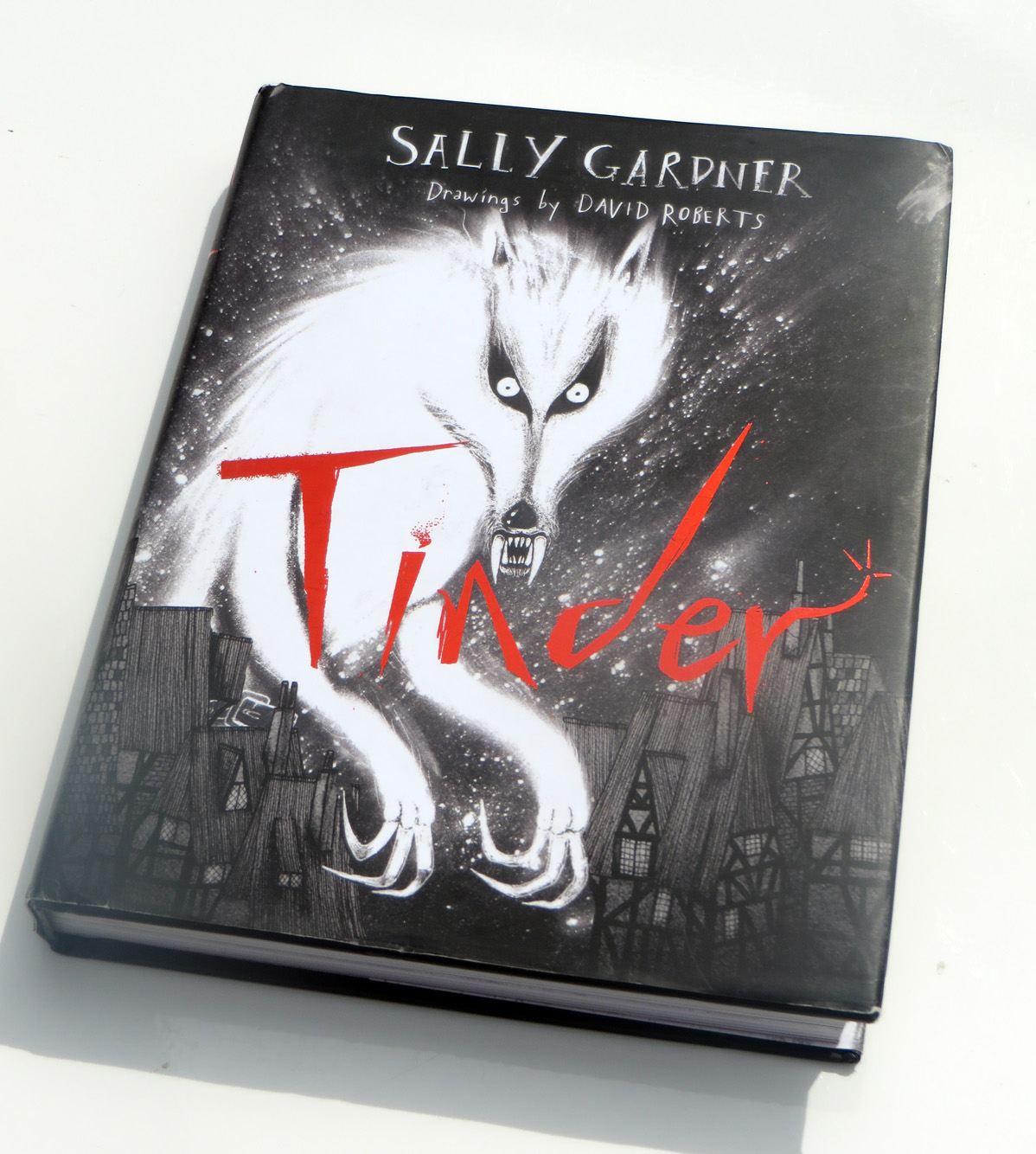
Carnegie Shortlist Review - Tinder by Sally Gardner with Drawings by David Roberts


Sally Gardner is no stranger to the Carnegie short-list, in 2013 her novel Maggot Moon scooped up the award (press here to read our review). Now she’s back with the amazingly beautiful Young Adult picture book; Tinder, which isn’t only up for the Carnegie but for the Greenaway too. So it is more than possible that Sally (and illustrator David Roberts) could walk away with an award in each hand!

Tinder is a testament to the power of fairy-tales, and their ability to evolve to be relevant in an ever changing society, as Sally takes her inspiration from Hans Christian Andersen’s dark and twisted tale, ‘The Tinder Box.’


Set in the war torn regions of Germany in the 15th century Tinder is a dark and evocative tale of one solider shun and flee the bloodied battlefields of Breitenfeld betting his future on the roll of enchanted dice.

“ ‘ I wait or no one,’ said Death.
‘You’ve feasted well today,’ I said. ‘What difference would my soul make?’
It was then that Death and his ghostly army vanished.”


The dice guide Otto through perilous forests populated with deserters, thieves and a mysterious stranger that transforms into a wolf by removing his belt. Dicing with death Otto happens by a traveller; a boy who is not quite as he seems.

“’It’s not fair that girls should be bound up in skirts. I would rather be a boy, then I would be free to travel like you’. He took his hat off and threw it down. All about him cascaded fiery curls and a young woman stared at me with defiant eyes.”

The pair fall in love yet in a land soaked in blood and defined by violence, the pair are separated as huntsman come to collect their prey; Safire leaving Otto to follow the dice in search of her.


Otto’s journey is one that brings terror and riches as he comes upon a wooden castle, home to the powerful Lady of the Nail, who sends Otto on a quest into the bowls of the castle to fetch something from under the watchful eyes of three gigantic wolves. The prize, a tinder box, becomes entwined in Otto’s destiny as he ventures on wards to save Safire from an arranged marriage and certain death.


The Tinder box brings blessings; wealth, the command over the three gargantuan lupines and a key to his ‘happily ever-after’ yet its price, a secret, which may well fashion his demise.

Tinder is written with rhythm of a fairy tales and brings a tale that’s woven with enchantment, betrayal, fear, and hope yet brings with it an image of the atrocities of war. In Tinder Sally Gardner explores the brutalities of war and the desperation of survival in a convincing fairy tale world, drawing from werewolf mythology making the story rich and layered. The book is beautifully illustrated on every page with black, white and red drawings by David Roberts that enhance the story adding to its eerie-gothic appeal. Despite the book being highly illustrated, due to some of its subject matter it is a book for older teenagers.