Showing posts with label illustrator. Show all posts

Wednesday, 18 July 2018

3D Review, ‘Is it a Mermaid?’ by Candy Gourlay and Francesca Chessa - Illustrator Interview with Francesca Chessa


Continuing on our 3D review of  'Is it a Mermaid' we are delighted to welcome  Francesca Chessa on to the blog to talk about visualising the story through her beautiful illustrations.

What was your favourite children’s book as a child?

My favourite book as a child was Tomaso written and illustrated by Vittorio Accornero, first published in 1944.

Tomaso talks about the life of a dog called Tomaso who was bought by a family of cats as a Christmas toy for the spoilt kitten of the house.

During the summer holidays, not knowing what to do with Tomaso, the cats leave him in the countryside, where Tomaso will meet a family of rabbits that will treat him as a friend, he will give his life for them.

I learned to read on this book it remained in my heart.


What is your favourite children’s book as an adult?

There are so many books I was inspired and that still inspire me that it’s quite impossible to me to choose just one.

The books I like more are amusing, have a good plot, a turning point and surprise me until the end.

My favourite books are the ones where text and illustration are necessary one to each other and you couldn’t imagine one without the other.


What do you think makes children’s books so inspirational?

I think that a good picture book needs to be intriguing, mysterious, funny and enveloping. It must be a book that every time you read, you can discover something new that increases your love for it.


Did you always want to be a children’s book illustrator?

I have always loved drawing and I have always loved reading and looking at the figures in the books. As soon as I realized that I could turn these my passions into a job, I thought I had found how to occupy my time working with passion and joy.


What is it like visualising other people’s characters?

When I work on a text of a writer and on its characters I try to figure out what the author wants to tell. Then I like to add some elements that belong to my world and my interpretation of the story, trying to create images that contains both our worlds.


Can you please explain a bit about your process of illustration?

For my illustrations I am taking inspiration from what I can read, I can see, I can hear, I can touch, I can taste. I like to think that I use all my five senses to develop an idea. The story concept comes first, then the main character, then all the story develops itself step by step by connections between characters and scenes.

I usually work together with the art director. Good art directors let you free but at the same time are able to show you a way and to get from you a better result than the one you could have reached just by yourself.


Francesca Chessa was born on a cold December day in a small north Italian town close to Turin.

She graduated in Architecture but, after some years of working as an architect, realised that she would rather paint animals and the things that surrounded her. Hence she did a course in Illustration.

Since 1997 Francesca has illustrated more than forty children's books working with publishers in various parts of the world including Italy, England, the US, France, Canada, Spain and Japan.

She has received mentions and prizes in a number of international competitions. She now writes her own stories as well as illustrating those by others and likes to feature her family and friends in these. She illustrates for Unicef and Amnesty International.

Francesca lives in an old house in the centre of Turin with her husband. Her studio is colourful, full of books and looks over a small courtyard garden. She loves reading, watching movies, cycling, swimming and skiing.

Thank you for stopping by, please pop back tomorrow to see our 'Is it a Mermaid' Story Sack feature! 

Thursday, 15 December 2016

Fabulous Festive Reads Perfect for Christmas Part One – Foxes, Magpies and Stars


With Christmas fast approaching it is entirely feasible that you are huddled on the sofa with the kids (maybe in front of an open fire, or the very least a working radiator) and you are looking for book to read together. But as you reach for you battered copy of The Lion Witch and the Wardrobe or The Box Delights again*, don’t despair, there are new festive books out there that can be enjoyed, and here are some of our recommends of recently published ones…

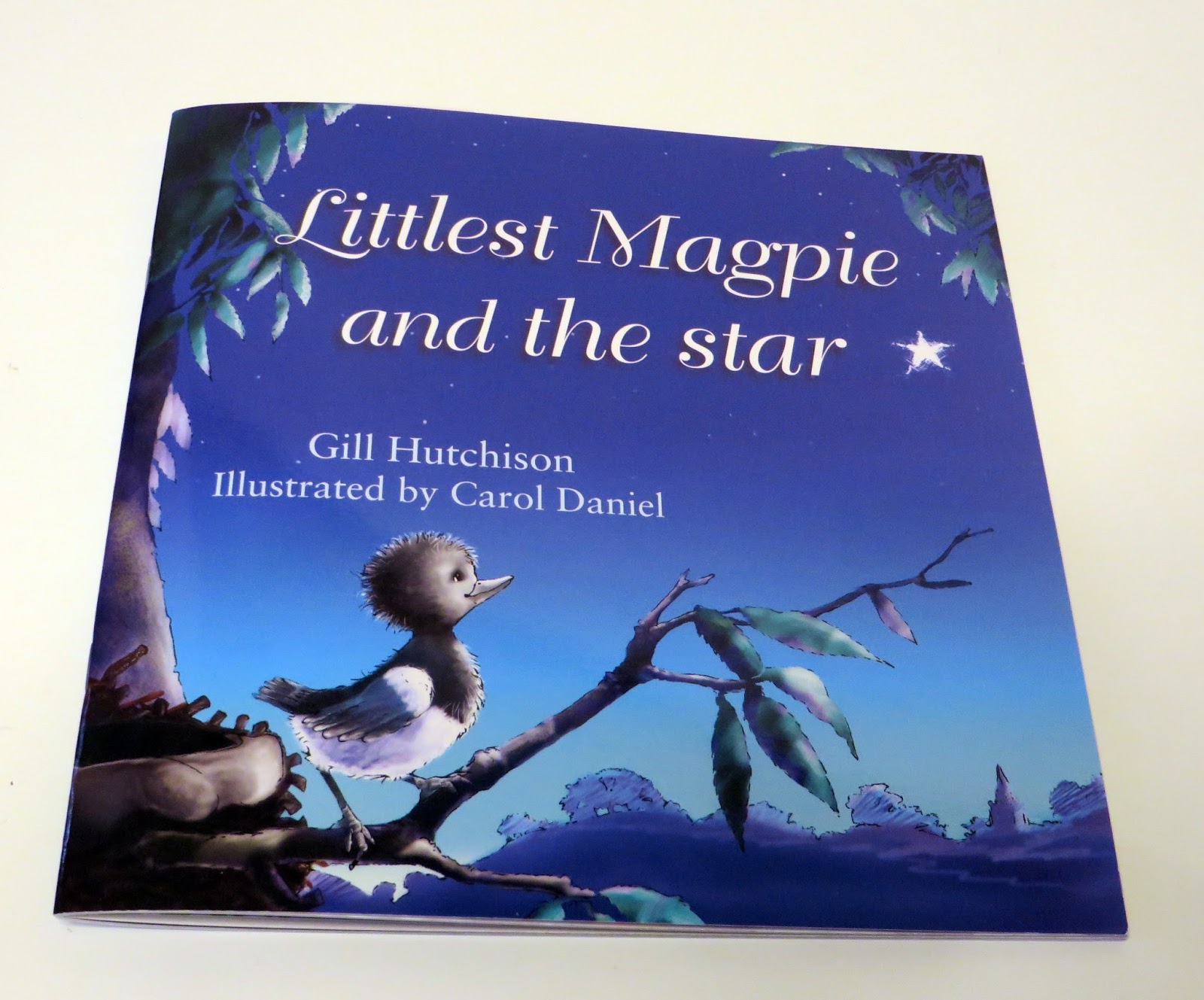
The littlest Magpie and Star by Gill Hutchison and Carol Daniel


The littlest Magpie and Star is a touching story about (you guessed it) the Littlest Magpie and his aspirations to catch and own the shiniest of all shiny things a star. But stars are very high, and the Littlest Magpie has a lot to learn first, like how to fly and even more importantly patience as the wise Old Owl tells him to wait for the snow before looking for a star of his very own. When Magpie is grown and the snow lie thick, he goes on the hunt for his star, and along the way he make some unexpected friends and get given a gift of a gift of… YOU NEED TO READ IT TO FIND OUT!


The littlest Magpie and Star, is a charming story with beautiful wintery-coloured illustrations by Carol Daniel, and I guarantee it’ll bring a tear to your eye, but perhaps not so much as the story behind its publication. Inside the back cover is a photo of the immensely talented author Gill Hutchinson, who wrote the story for her granddaughter, and whom had been a writer for many years with the aspiration of publications. Sadly, just as publishers were really getting interested in Gill’s work she passed away. Her dreams of becoming published lived on, and a dedicated group of her friend’s crowd funded the money and both created and published this beautiful book.

So, The littlest Magpie and Star is a book with not one but two moving heart-warming stories within it. This book is truly a lovely read, and if you wish to purchase a copy please visit the web-site: The Littlest Magpie.

The White Fox by Jackie Morris


Jackie Morris is an award winning author and illustrator who specialises in energetic watercolours of wildlife. The White Fox is a stunning book featuring her exquisitely executed illustrations, along with the story of Sol, a twelve year old living with his father in Seattle, a long way from his home and family in Alaska. Sol’s life isn’t ideal, his Dad is mourning and working long hours at the docs and the kids at school ostracize him due to cultural and visual differences. But everything changes when Sol strikes up an unlikely friendship with an equally displaced White Artic Fox. As boy and fox bond, a sequence of events unfold that bring Sol and his father closer together and instigates a journey back to home and happiness.


The White Fox is visually stunning and is full of positive themes about the harmony between wildlife and humans plus the importance of family and heritage.

The Fox and the Star by Coralie Bickford-Smith


Ok, I think I should set this straight; when I started compiling this post I didn’t intend there to be a theme (other than wintery tales), but I suddenly realise that it has become very well, foxy, starry and magpie-y. That said, I offer no apology as these have all been selected on merit, and just happen to coincidently create a theme by their juxtaposition.

As I said, all these books have been picked by merit, and The Fox and Star is no exception, it or more accurately they, as I’m reviewing both the hardback and paperback which are subtly different but equally exquisite.

The Fox and the Star tell the tale of fox, whose only companion is star that he follows through the forest, but then one night when fox looks up, the star is nowhere to be seen. Lonely fox, searches for star to avail, until one day something changes, the leaves fall and when he looks up he sees the and his friend star along with thousands of other stars in the winter sky. 


Both books, are stunning; from the very ‘Filo Society esk’ fabric covered hardback with white cover illustrations, or the larger format picture books, with bright cover, with autumn colours which offers a vintage almost ‘Rosie walk’ feel. Inside the book share the same rich illustrations; highly stylised with repeated patterns and limited pallet, creating an atmospheric and aesthetic feast for the eyes, which will be enjoyed by children of all ages.

Thank you for stopping by and reading our first instalment of recommended winter reads, please stop by again for part two, where we will be talking; elves, dinosaurs and snow queens.


*please do not get me wrong both The Lion Witch and the Wardrobe or The Box Delights are great books to read all year around as are the rest of the amazing children’s classics, we are just offering an alternative!

Friday, 31 July 2015

All hale the amazingly talented Chris Riddell - a big Space on The Bookshelf welcome and celebration to the new Children’s Laureate!


In June, we saw the sad stepping down of Malorie Blackman who had excelled in her role of Children’s Laureate which she held since 2013. But the sadness was soon eclipsed by the excitement and jubilation caused by the announcement that multi-talented illustrator and writer Chris Riddell had been appointed as Children’s Laureate for 2015-2017. So to celebrate the new Children’s Laureate we thought we’d share with you some of our most favourite Chris Riddell books…


We start with Nicki…

From its idiosyncratic cover, vibrant purple edging and those wondrous silver skulls everywhere, ‘Goth Girl’ has been one of the most distinctive books to have been published in the last few years.

The sort of book you just have to pick up and open. And cherish.


Hardly surprising that it is the creative work of one of our foremost writer/illustrators, Chris Riddell, because it takes a very special talent to produce a book as stunning as this.

The first thing you notice about it is that it is full of startling images, featuring a range of unusual characters and inventive creatures (some with the heads of creatures and the heads of humans), which stare out of the pages at the reader in a challenging way.

But its uniqueness does not stop with the images.

We meet Ada Goth, clumping around in big boots so that her father (mad, bad and dangerous to gnomes Lord Goth) can hear her approach and avoid her as she reminds him too much of her mother (Parthenope) and tries to make sense of the bizarre world she inhabits.

The story has a surreal nature, with everything twisted slightly off-kilter. It hails very close to ‘Alice Adventures in Wonderland’ in its style and its narrative – a story of bizarre imagination that doesn’t play safe in the slightest.


It’s a mystery, set in the creepy Ghastly-Gorm Hall, so vast that lonely Ada Goth has not yet been in all the rooms. (The book opens with a map to help and who doesn’t have a bit of a soft spot for books with maps in them?)

The vocabulary is complex, the names subtly full of sly literary allusion. When Ada first encounters a ghostly mouse and asks what he is called, he replies: ‘Call me Ishamel’.

Although it’s a huge bestseller, was it, in fact the obvious book that was going to be such a runaway hit? It really stands out in its inventiveness, vocabulary as well as use of illustration, which is bold in itself and in every way is not at all your usual children’s book.

What it is, is a brilliant example of a bold writer, teamed with a bold publisher, producing something that is so different – and so successful.

It’s been hugely influential on girls’ reading. Schools were inhabited with more than a handful of purple-gowned Ada Goths on World Book Day. Although it hasn’t yet seen many imitators (although the book world hopes there will be many), there has certainly been an accompanying rise in sales of Chris’s previous illustrated series for newly-confident readers, Ottoline.

A couple of inventive librarians have concealed the cover in brown paper (shame!) but have thus added many boys Ada’s fan base, drawn in by the stark, pretty-scary line drawings inside.

Malorie Blackman has done great things in her time as children’s laureate by focusing particularly on recognising some of the great writing for teens.

Chris Riddell is possibly our best-known author of illustrated books for older readers and is stepping into her shoes. Hopefully this might see an increase in the recognition of just how brilliant illustrated books are for children – and how very in short supply they are.


One might note there has been a rise in illustrated books, but most of these have tended to be funny books, often with comic-style illustration. A quick glance at the shelves might give the impression that there is plenty of illustrated fiction around. There are also plenty of illustrated classics around.

But there really is a shortage of books aimed at the same age range as ‘Goth Girl’ that have the same overall excellence in both innovative use of illustration and design.

If Chris Riddell leaves a legacy – please let it be more illustrated modern books for children.

More please!


Then (me) Sally...


Both Nicki and Claire are talking about Chris Riddell’s penned and illustrated books, and coming from an art background, I’m going to celebrate Chris Riddell’s amazing illustration. I’m sure that the decision to elect Chris as Children Laureate took in to account his talents to tell a story with either words or pictures.


 Personally I first came across his illustration work which accompanied and enhanced the Neil Gaiman’s ‘The Graveyard Book’. I was instantly struck by the quirky characterisation and the skilled monotone workmanship with gothic undertones. The combination of Gaiman’s words and Riddell’s images was ‘right up my street’ and I began to amass and read their other collaborations. To me the pairing of Gaiman and Riddle is one of those rare partnerships where the two become synonymous in my mind, you see one and your mind instantly thinks of the other. This is a rare and beautiful thing of which I can only think of a few other examples; ‘Milne and Shepard’, ‘Dahl and Blake’ and ‘Donaldson and Scheffler’.


Riddell’s characterisation is highly stylised and executed in exquisite ink, but what makes them so special is the that each one seems to have an edge - hinting that the character is multifaceted with hidden depths making them more intriguing. Chris Riddell is also a master at humour, visualising and drawing quirky characters and scenes, like the penguins from Paul Stewart’s Fergus Carne’ or the ghouls from Witchworld by Emma Fischel.


Chris Riddle’s illustrations have adorned many book covers and pages by other talented writers and to me and my children it’s is a sure sign that book will be suit our family’s pallet; that the story will be funny, quirky and a wee bit gothic.


Finishing off with the lovely Claire...


Ottoline and the Yellow Cat is a wonderful book and the first in the charming Ottiline trilogy.


Ottoline Brown is left in the care of her capable nanny, Mr Munroe, while her parents are travelling the world. When pets begin to go missing and there are some mysterious robberies, Ottoline makes a connection between the crimes, enlists the help of Mr Munroe, and an adventure ensues.


It is liberally illustrated in Chris Riddell’s usual fun style, which makes this book massively accessible to reluctant readers and younger readers, and there is something new to notice every time you open it. There’s an endearing whimsy about both the writing and the illustrations, and a madcap heroine who reminds me a little of Pippi Longstocking.


Thursday, 26 February 2015

3D Review - How the Library (not the prince) Saved Rapunzel - Illustrator Interview with Rebecca Ashdown


Rebecca was born in Chichester on the south coast and grew up right by the sea. She has always had a passion for making art. Now, after years of working as a graphic & motion designer, filmmaker and vector artist, she has returned to her first love; writing and illustrating children’s books.


What was your favourite children’s book as a child?

I’m going to cheat here! Both ‘Where The Wild Things Are’ by Maurice Sendak and ‘The Very Hungry Caterpillar’ by Eric Carle have always been firm favourites. I adored my first Richard Scarry book, which was a Christmas present, and I couldn’t possibly leave out The Mr Men!

I read a lot of fiction - ‘Tom’s Midnight Garden’ by Phillipa Pearce and other tales by Alan Garner and Ursula LeGuin. Living with a library at the end of my road really helped.

What is your favourite children’s book as an adult?

Again, I could never choose one favourite but two of my picture book heroes are John Burningham and David McKee who both have a wonderful, witty perspective on childhood experience. I’m a big fan of Sara Fanelli, too. For older children, Eva Ibbotson is just magical and Patrick Ness is completely enthralling.


What do you think makes children’s books so inspirational?

I think that reading a good book inspires a feeling of belonging - a sort of empathy. We’re invited into a world and to experience it alongside real characters. We aren’t passive onlookers - reading is a two-way conversation. These adventures can be as exhilarating as a real life.

Did you always want to be an illustrator?

Yes! I still have a book of poems that I wrote and aged 9. They are all illustrated and bound, complete with decorative cover. I entered a lot of art competitions as a child, too, which was a great way to find out what other people thought about my pictures.


How did you become an illustrator?

I’ve always drawn a lot, ever since I was tiny. So, after a Foundation course, I trained in illustration up to Masters level. During my final year, I began working for BBC Education as an illustrator for their online educational games site. This led me into becoming a web and print designer for many years, then later into animation and filmmaking. But I never stopped drawing.

It was only after I’d had my own children and began reading the books I’d always loved, that my real passion was reignited. I was taken on by The Bright Agency in 2013, who expertly guided me into the world of publishing. It’s great to have experienced two very different career paths to get to this point.


What is it like visualising other people’s characters?

It’s great fun. It’s a bit like being a detective, with no right answer! Sometimes there are clues in the story, which suggest ideas for a character. Certain texts just throw up an immediate image and sometimes a publisher or author might have their own ideas or starting point. Either way, imagination always plays a big part. In many ways, fresh eyes make it a lot easier than working with a text I’ve written.


Can you please explain a bit about your process of illustration?

Well, every project is different. For me, there’s a lot of emphasis on the characters, as I want them to be believable. So, I think of them as puppets in a theatre and have certain questions as I draw them; how do they move, dance, sleep etc. Then I have to create the scenery, the props and so on, until it becomes a small stage; a little world.

Drawing is central. The more I draw something, the more familiar it becomes - which gives the line more energy and fun. I use a variety of media but I try to infuse the illustrations with as much spontaneity and life as I can, regardless of the final look and feel.


What is your favourite fairytale?

Tricky! I’m really fond of Hans Christian Andersen’s Fairy Tales. ‘The Little Match Girl’ is a favourite, although terribly sad. I’d recommend Angela Carter’s books to bigger children who prefer a darker fairy tale experience!


Friday, 8 August 2014

WOW! Graphic Novels, Comics & Magazines - Interview with Writer, Illustrator, Cartoon-Creator and Graphic-Novelist Dave Shelton


Dave Shelton is an illustrator and writer, his novel A Boy and a Bear in a Boat was shortlisted for the 2013 Carnegie, to read our review press here. Dave also creates comics, both penning the text and inking the illustrations, his work can be found in the The DFC Comic (forefather of The Phoenix) and as graphic novels published by The David Fickling Library.

What was your favourite children’s book as a child?

This is a question I get asked quite a lot and I really struggle to answer it, I’m afraid. I remember reading quite a lot when I was a child but I don’t remember having any particular favourite book at any stage. I do have fond memories of Dr Seuss books in general though, and The Cat in the Hat in particular. There’s a scene in a Harrison Ford movie (I forget which one) and I was watching it while visiting my parents sometime in my thirties, I think. My dad happened to walk into the room as the Harrison Ford character was reading The Cat in the Hat to his daughter. As he did so, my dad started reciting the words in time with him, still remembering them from when he read it to my brothers and me 25 years or so earlier. So I guess that must have been a favourite with us - one of those “Again! Again!” books.


What was your favourite children’s magazine/comic/annual as a child?

I read a lot of comics and annuals as a child but the one that really turned me into an obsessive was the science fiction comic 2000AD, the home of Judge Dredd, among many other characters. I’d avoided it for the first year or so of it being published but then I read a copy that my dad bought me when I was off school ill (we always got comics and Lucozade when we were ill) and I quite liked it. Then my older brother and I started to get just the occasional copy, and we liked it more and more. Then at some point we started having it delivered weekly by the paperboy, and I saved all the back issues in a big suitcase in my bedroom and read and reread them, and I knew the names of my favourite artists and started trying to draw like them. Then I was off on the slippery slope to eventually (occasionally) writing and drawing comics for a living myself.


What is your favourite children’s book as an adult?

I’m not sure what my absolute favourite children’s book is now. I’ve just been one of the judges for the Branford Boase Award, and I loved the book we chose as the winner for that: Infinite Sky, by C J Flood. It’s just so beautifully written. But I still love a good picture book too, so I could easily choose Jon Klassen’s I Want My Hat Back, for instance, because it’s so hilariously funny. Or there are the comics that I love to read to my step daughter, like Tintin (my favourite of those is probably The Black Island) and Asterix (Obelix and Co. is my top choice of those.)


Do you read comics/graphic novels as an adult? If so which is your favourite?

I most certainly do read comics and graphic novels (though I tend just to call all of them comics) as an adult. My earliest memory of reading is of me reading a comic while on holiday at the seaside, and I carried on reading them all through childhood and into adulthood. There was a time when I fell a little out of love with them simply because there didn’t seem to be very much exciting new work coming out (I think this was around the early 2000s) but now it kind of feels like we’re in a ridiculously rich golden age of great and beautiful comics being published all the time, so it’s actually rather hard to keep up with it all. Some of my favourites these days are from Europe. There’s a lot of really lovely work over there only a tiny fraction of which, sadly, has been translated into English. A couple of my favourites that have are: Green Manor, by Fabien Vehlmann and Denis Bodart; and Isaac the Pirate, by Christophe Blain. The UK scene is very vibrant too now though with some wonderful titles coming out from publishers like Selfmade Hero, Blank Slate and Nobrow. Favourites include Rob Davis’s adaptation of Don Quixote, Joe Decie’s work, Jon McNaught, and, oh, loads of others. And of course, specifically for children, there’s The Phoenix, a proper, high quality weekly comic full of original stories by the likes of Gary Northfield, Jamie Smart and the Etherington Brothers. An embarrassment of riches.


What do you think makes children’s books so inspirational?


I think children make children’s books so inspirational. Because children tend to be less constricted by any kind of rules about how stories can be told this gives authors a freedom to be a little bolder, take more risks with both the story itself and the way that it’s told. There’s less of a sense that some things just aren’t allowed.

Did you always want to be an illustrator/ comic maker?

I didn’t always want to be an illustrator/comic maker, but I think from about my mid teens I had at least some idea that I’d like to somehow do something involving drawing for my living. So I studied on a couple of illustration courses at college and l started to get some illustration work here and there. Then little by little I drifted toward drawing (and writing) comics and from there I’ve drifted further still into writing and illustrating prose novels for children. But it’s mostly been happy accidents that have got me here rather than any sort of a plan.


When writing and illustrating a comic, does the story or the pictures come first?

I don’t really know which comes first when I make a comic. My process is a bit of a mess. Sometimes I’ll just draw the characters for a while and play around making them do things. Then that might give me some elements that I’ll want to work into the story. Then I might try to work out some sort of overall structure for the story and begin to, really badly, draw the pages in a fast, doodly way, just to work out what happens when and roughly how to tell it, mostly working on the timing of the action and jokes. Then once I’m reasonably happy with that I’ll probably start to draw the pages up properly. But, as I say, it varies a lot. The only thing that stays the same is that it always takes far too long.


How does creating a comic differ from illustrating books?

Comics are harder.